It’s a sad commentary, but during the holiday season, when most of us are thinking of family and friends and of goodness and joy, there are heartless crooks looking to take advantage of one’s goodness by scamming them.
On December 3rd at a Security Summit, the Internal Revenue Service (IRS) announced that the 10th National Tax Security Awareness Week hopes to raise awareness about tax-related identity theft and scams as the holidays and the upcoming tax season approach.
The Security Summit is a coalition of the IRS, state tax administrators, tax software companies, the tax professional community and others in the larger tax community, organized to combat tax-related identity theft through a public-private sector partnership that strengthened internal protections and raised awareness about security threats.
“With the holiday shopping season underway and tax season quickly approaching, we are urging taxpayers and tax professionals to take extra steps to protect their financial and tax information,” said IRS CEO Frank Bisignano. “During this holiday season, people face the heightened risk of identity theft as criminals ramp up efforts to trick people into sharing sensitive personal information: identity thieves might use this information to try filing false tax returns and stealing refunds.”
The IRS stated that the work of the Security Summit is to strengthen internal systems and share information across the tax system about fraudsters continues to show results. Since its inception, the work of the Security Summit has helped protect millions of taxpayers against identity theft and prevented billions of dollars from being wrongly paid out to fraudsters.
As the IRS and the Summit partners have strengthened their systems, identity thieves have increasingly turned their attention to stealing underlying tax and financial information from taxpayers, businesses, and tax professionals in hopes of slipping authentic-looking tax returns through the defenses.
“There has been an increase of these activities on social media, including inaccurate tax advice that continues to mislead taxpayers. To help counter this, many of the Security Summit partners have joined together to form the Coalition Against Scam and Scheme Threats. This group will be increasingly active during the upcoming tax season,” the IRS stated.
“A key tool in identifying and defending against these identity theft scams is the Identity Theft Information Sharing and Analysis Center, which was developed by the IRS and Security Summit partners to better identify and coordinate against fraudsters. As the group has strengthened defenses inside the tax system to spot emerging scams, identity thieves continue to look for new ways to obtain sensitive personal financial information to file fraudulent tax returns, making tax professionals and the sensitive tax information of their clients a target for scam artists.”
The IRS and Security Summit partners want taxpayers, tax professionals and businesses to be extra aware during the upcoming holiday season for the threats listed below.
The Federal Trade Commission (FTC) also issued warnings about holiday scams.
“Scammers are everywhere online – especially on social media,” the FTC stated. “They sometimes impersonate real companies and run ads for brand-name products at unusually low prices. But if you click the link in the ad, it could send you to a “scammy” website designed to take your money in exchange for a counterfeit item, something that looks completely different from the picture in the ad, or nothing at all.”
When you’re shopping online, the FTC stated, here are some ways to protect yourself during the holidays and year-round:
If you think you were scammed, file a report with the FTC at ReportFraud.ftc.gov.
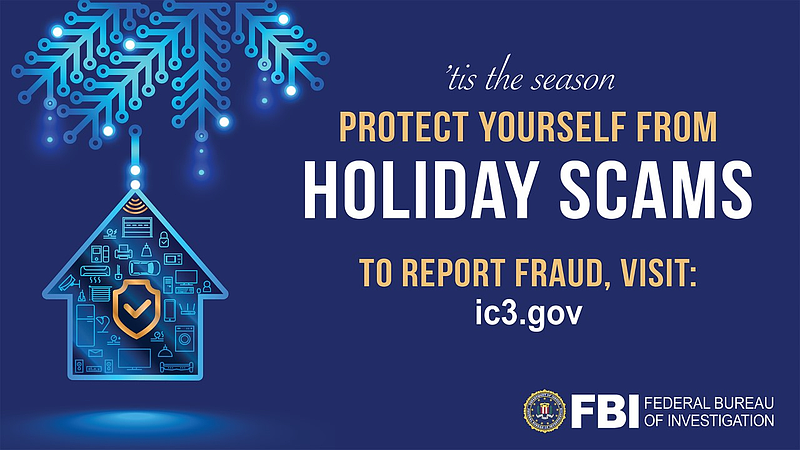
The FBI field office in Philadelphia notes that the holidays are underway, and with charitable giving and online shopping surging, the FBI reminds communities to stay alert for schemes designed to steal your money and personal information.
“The holiday season is a time to bring people together, but scammers are working to separate you from your money and personal information,” said Wayne A. Jacobs, special agent in charge of FBI Philadelphia. “Whether you are shopping, connecting with loved ones, or looking to give back, there are small, but important steps everyone can take to better protect themselves online: if you didn’t call them, don’t tell them—never share personal or banking information on an unsolicited call; If the link is a mystery, the risk isn’t — don’t click unrequested links; use secure payment methods; and verify charitable organizations before donating. If you have any doubt, reach out—call the FBI at 1800-CALL-FBI or report it at IC3.gov.
“If a deal you find this holiday season seems a little too good to be true, it probably is.”
Some of the most common holiday shopping scams reported to the FBI include:
The FBI Philadelphia field office also reminds the public of the charity fraud scams criminals deploy this time of year to cash in on your kindness.
“Charity fraud schemes seek donations for organizations that do little or no work—instead your charitable donation goes to the fake charity’s creator. Scammers can contact you in many forms, from e-mails, text messages, cold calls and social media,” the FBI stated.