
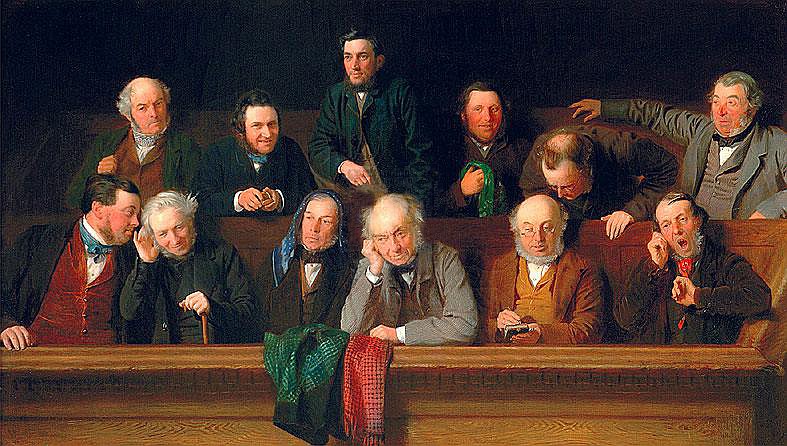
"The Jury" by John Morgan, painted in 1861.
Recently I received an email from the son of former Pennsylvania state senator, Vincent J. Fumo about my book, Death in Philadelphia.
The ex-senator’s son, Vincent E. Fumo, wrote:
“I am about 30% through your book and I wanted to tell you a story that I think you may find interesting. Of course this was years ago and I don't remember all the details correctly, but I do remember the highlights.”
Vince told me that a few days before her murder, Kimberly Ernest, the young female jogger whose body was found at the bottom of a stairwell at 21st and Pine Streets in the early morning hours of November 2, 1995, was at a party he attended with his girlfriend at the time. Also at the party was a friend of his, plus his friend’s roommate. Fumo said the group got into a discussion about sexual personal fetishes, at which point Kimberly Ernest shared her private fantasies. This revelation aroused the interest of the roommate of the invited friend who then apparently probed Kimberly for details.
As Vince wrote, “He also seemed to be interested in her.”
“The roommate dressed like our friend, ate the same diet, worked out the same way, cut his hair the same way, etc. He was a weird dude and gave off odd energy.
“Sure enough, a day or two later Kimberly was dead of strangulation and was attacked in a rape like way. My girlfriend and I were freaked out at the time and were convinced that the roommate had done it. We guessed he wanted to impress her by giving her exactly what she wanted but for some reason it went too far and she died.
“We called the police and tried to tell them but they were not interested at all. It seemed to us that they were sure they had the people involved (Richard Wise and Herbert Haak).
“Last part of the story,” Vince concluded, “the roommate killed himself a short time later by hanging himself. To this day my ex-girlfriend and I are convinced he did it, which is why I bought your book and started reading it.”
Vince Fumo invited me to interview his ex-girlfriend, something I have not yet done, but his email got me thinking about crime and punishment.
Writing about crime and criminals is not something that all writers do well, but since we live in a world of crime and criminals, most people pay special attention to these stories.
One great French writer who wrote about crime and criminals was Andre Gide (1869-1951). Born to a wealthy family, as a young writer Gide had no financial worries and could afford to be experimental in his work. Many critics view Gide as the greatest journalist of the 20th century.
Gide’s slim book, Judge Not, is really a testament to Gide’s fascination and obsession with crime and punishment. In novels such as Lafcadio’s Adventures, Gide often explored the criminal mentality as well as the criminal’s place in society. In Judge Not, Gide recorded his impressions and analyses of judicial cases while serving as a juror. He wrote about the cases in depth, examining both the facts of the case and the background of the accused in a way that dovetailed with his lifelong rejection of traditional morality.
Many of the cases in Judge Not involved murder with adolescents as the accused. Although Gide declared that his writings on judicial cases were not “literature,” they are nevertheless artful journalism in which Gide often saw facts that judges and jurors overlooked. Although some critics have deemed Judge Not too graphic in its descriptions of violent crime, such charges appear illogical given the book’s subject matter.
Gide was almost sixty when he wrote Judge Not. He never turned down jury duty and he even advised other writers to do the same. Now, the jury system in France differs from the American system. For example, jurors may speak out and ask the court to put certain questions to a defendant or witness. With this rule in mind, Gide wondered, “Did I dare use this prerogative? It’s hard to imagine how unsettling it is to rise up and speak in front of the court….”
He then asks, “Does an innocent man sound more eloquent and less disturbed than a guilty one?” Gide concluded that as soon as an innocent man feels that he isn’t believed, he might be even more disturbed since he is less guilty. “He’ll overdo his statements, his protests will seem more and more disagreeable, and he will be out of his depth.”
The French writer was definitely in his depth as he took notes on case after case. What upset him most, he confessed, was the tendency among jurors, during serious cases when it was clear that the defendant was not guilty, to opt to punish the defendant anyway.
“To these jurors some punishment is necessary,” wrote Gide, “so just in case, let’s punish the man, since he’s the one offered to us as a victim. But since we’re not sure, let’s at any rate not punish him too much.”
Gide was often appointed foreman because of his professional stature.
His attention to detail allowed him to see pertinent facts to which other jurors were blind. Consider the case of Charles, a 34-year-old coachman, who allegedly stabbed his mistress, Juliette, to death. As witnessed by Juliette’s landlady, the killing would appear to be a simple case of murder. And this was what the jury saw, despite the defense attorney’s claim that Charles’s act “was done without the idea of killing being quite specified in his mind.”
Gide considered the attorney’s claim that the proof of this lay in the distribution of stab wounds and then posited: “Why didn’t the defense attorney go further and say that, not only had Charles not wanted to kill, but that he dimly tried, while mutilating his victim, not to kill her and that, doubtless so as not to kill her, he had grabbed the knife just next to the blade, which is the only way that the stabbing could have been so intense yet cause such shallow wounds?”
Fed up with the appalling incompetence of jurors — let’s not forget that in 1997, Haak and Wise were acquitted in the killing of Kimberly Ernest — Gide recorded how the jurors later changed their minds after a sentence of life imprisonment at hard labor was handed down. Stunned by the severity of the sentence, the jury would often choose to take another look at the case and obtain a reprieve.
Then there was the case of a teenager named Cordier, who got involved with two other young men in the killing of a sailor after a foiled robbery attempt. Here the jury only saw one thing, Cordier’s prior offenses.
“No sooner were we in the jury room than a tall, thin, white haired foreman pulled from his pocket a paper on which he had written all the charges against Cordier and, most important, his previous convictions. In truth these would dominate and determine this latest verdict. That’s how difficult it is for a juror to not consider a previous conviction as an indictment and to judge a defendant outside the shadows that a previous conviction cast on him,” Gide wrote.
In another case, a teenage servant, Marcel Redureau, hacked to death the family of his employer. It seems Marcel was set off by the father calling him a “lazybones” and telling the boy that he hadn’t been at all happy with the boy’s work for some time. “At this remark,” Gide wrote, “the irked Redureau stepped down from the winepress, armed himself with a wooden hammer, a kind of fifty-centimeter-long bludgeon that was within his reach, and struck several blows at the head of his master, who sank down groaning, letting go of the bar…”
Redureau then went on to butcher the three children, the grandmother, the mother, and the housemaid.
Gide quoted the pathologist on the Redureau case: “Specialists who work on pubescent psychology have noticed that in schools the largest number of cases of subjects liable for punishment for bad behavior, disputes, and assault and battery occur in the fifteenth year, because on reaching that age, young people have minimal control of their primary impulses.”
This brings me back to Richard Wise, who was just eighteen at the time of the Ernest murder, an age that put him dangerously close to the pathologist’s “primary impulse” assessment. Having had a street encounter with Wise just three months prior to the murder, I saw and felt what to me seemed like an authentic killer’s instinct.