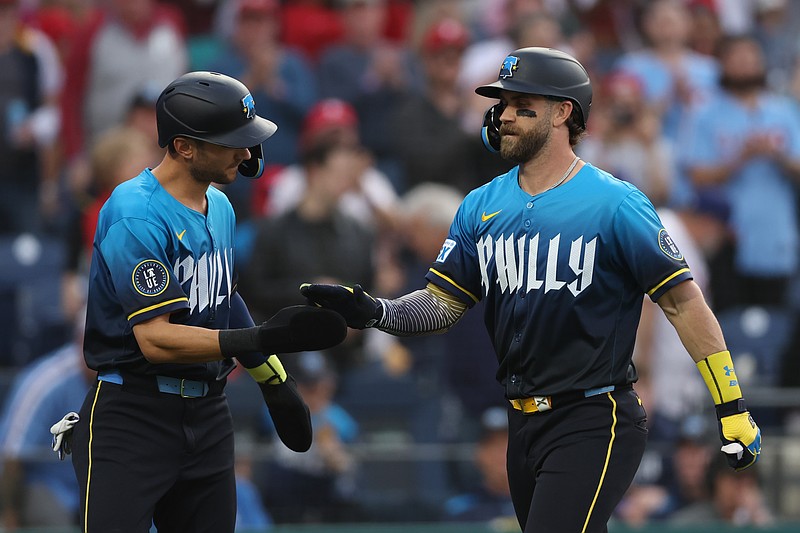
Apr 18, 2025; Philadelphia, Pennsylvania, USA; Philadelphia Phillies first base Bryce Harper (3) reacts with shortstop Trea Turner (7) after hitting a two RBI home run against the Miami Marlins during the first inning at Citizens Bank Park. Mandatory Credit: Bill Streicher-Imagn Images Bill Streicher
The Phillies owe $56,062,903 in luxury tax threshold penalties in 2025, according to The Associated Press.
Per the AP, the Phillies will pay the fourth-highest luxury tax penalty for this past season, behind only the Los Angeles Dodgers ($169.4 million), New York Mets ($91.6 million) and New York Yankees ($61.8 million).
In total, nine teams — the Dodgers, Mets, Yankees, Phillies, Toronto Blue Jays, San Diego Padres, Houston Astros, Boston Red Sox and Texas Rangers — will make payments for exceeding one of the luxury tax thresholds. The payments are due by Jan. 21.
This is the fourth consecutive year that the Phillies have topped one of the luxury tax thresholds, but this will be by far the largest penalty they have paid. By comparison, the Phillies paid $14.4 million last year, so they're seeing a more than $40 million increase year-over-year.
Teams who pay what the league calls the "competitive balance tax" three or more years in a row face a 50% tax on all overages, as opposed to a 20% tax in the first year.
The CBT is also a tiered system. For 2025, the luxury tax threshold was $241 million, the first surcharge $261 million, the second surcharge $281 million and the third $301 million. The first surcharge comes with a 12% tax, the second 45% and the third 60%.
If you combine those two charges, that's how the Phillies arrived at paying over $56 million in luxury tax penalties this past season.
While the Phillies could reset their CBT tax rate if they went under the luxury tax threshold for a season — it will be $244 million in 2026 — that's obviously not going to happen. Even without having re-signed J.T. Realmuto or acquired another starting catcher, the Phillies are projected to have a $301.5 million payroll in 2026, per Spotrac.
With the collective bargaining agreement set to expire after the 2026 season and labor and management very divided on whether the current economic system is working, it's unclear whether there will be drastic changes to the luxury tax penalties in the next CBA.