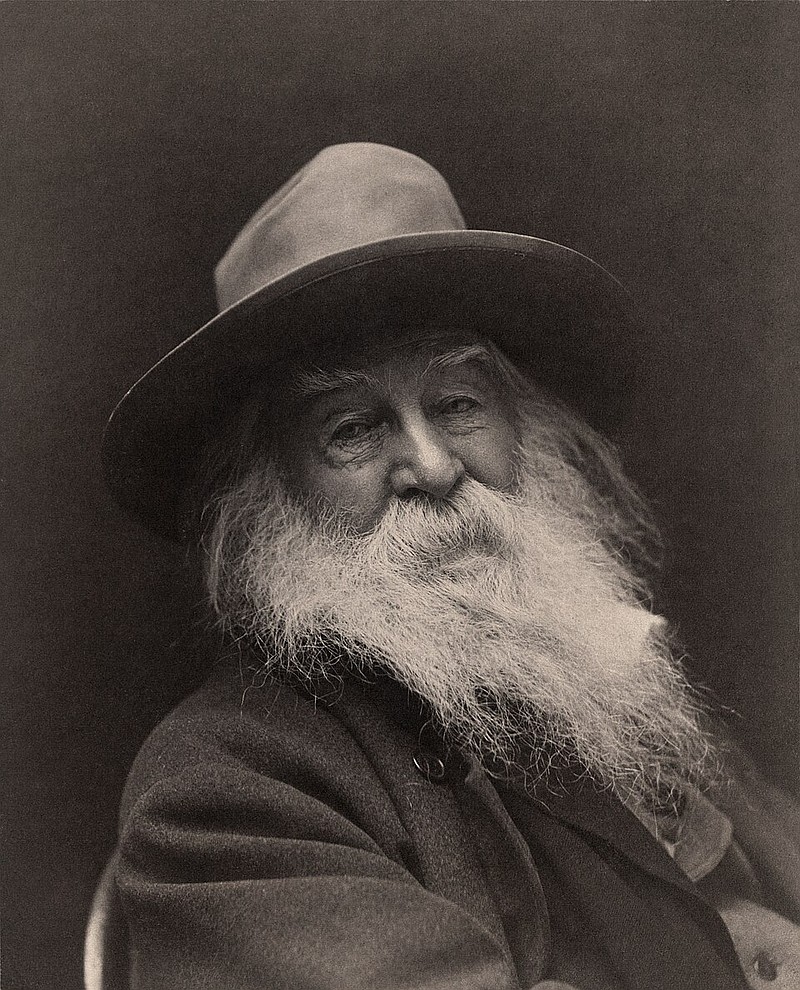
The poet Walt Whitman visited Germantown on a number of occasions. Perhaps his most noteworthy visit was recorded by Katherine Abbott Sanborn (1839–1917), a New York City newspaper columnist and author who described the au naturel bard’s behavior in the Germantown home of Mrs. Hannah Whitehall Smith in her book Memories and Anecdotes:
Sanborn goes on to describe how a Miss Willard, a crusader in the temperance movement, happened to be present. She writes:
“Whitman was rude and aggressively combative in his attack on the advocate of temperance, and that without the slightest provocation. He declared that all this total abstinence was absolute rot and of no earthly use, and that he hated the sight of these women who went out of their way to be crusading temperance fanatics. After this outburst he left the room. Miss Willard never alluded to his fiery criticism, and didn’t seem to know she had been hit, but chatted on as if nothing unpleasant had occurred. In half an hour he returned; and with a smiling face made a manly apology, and asked to be forgiven for his too severe remarks. Miss Willard met him more than half-way, with generous cordiality, and they became good friends. And when with the women of the circle again she said: ‘Now wasn’t that just grand in that dear old man? I like him the more for his outspoken honesty and his unwillingness to pain me.’”
Sanborn goes on to explain how the guests labored with “Walt” to induce him to leave out certain of his poems from the next edition of Leaves of Grass.
“Mrs. Hannah Whitehall Smith went to her room to pray that he might yield, and the husband argued. But no use, it was all ‘art' every word, and not one line would he ever give up. The old poet was supposed to be poor and needy, and an enthusiastic daughter of Mrs. Smith had secured quite a sum at college to provide bed linen and blankets for him in the simple cottage at Camden. Whitman was a great, breezy, florid-faced out-of-doors genius, but we all wished he had been a little less au naturel.”
Walt was born on May 31, 1819, in West Hills, New York, and died on March 26, 1892, in his Mickle Street house in Camden. He went to a Brooklyn public school but dropped out at age eleven, a common thing in those one-room schoolhouse days. He didn’t write very much about his school experiences, although he did manage to write a short story, “Death in the School Room (A Fact).” The story detailed the frequent use of corporal punishment by teachers in those days. You might say that public school life then was the reverse of what it is today: tyranny by students.
As a young writer, Walt liked to concentrate on themes like cruel or apathetic parents and their depressed, angst-ridden sons.
One of the poet’s first jobs was in the printing office of Samuel E. Clements, a Quaker who wore an enormous broad-brimmed longhorn hat in the summer months. According to one of my favorite Whitman biographers, Jerome Loving, young Walt learned how to “parse and spell” at Clements’s composing table, the same way that Benjamin Franklin and Mark Twain learned to write. The first newspapers in America were simple operations — the reporter was often also the printer. That later changed when the printing was done separately. Young Walt worked for a variety of printers. Later, he became a schoolteacher but returned to printing when he started his own newspaper, The Long Islander.
The best part of having your own newspaper, Walt recalled, was delivering the papers on horseback. Walt’s earliest published poem was “Our Future Lot,” about the common denominator that unites humankind: death. Walt also wrote essays about the evils of smoking, flogging, fashion, materialism, and the stupidity of quarreling.
Loving reported that in 1840, a former student of Whitman’s recalled that “the girls did not seem to attract him.…young as I was, I was aware of that fact.” Part of the universal appeal of Leaves of Grass, the poet’s greatest work, was its bisexual view that both men and women can be equally desirable comrades in the arena of love. Walt, it could be said, was the seminal poet of male bonding.
But he was too much of a poet to be a good newspaper or editorial writer. One has only to read Democratic Vistas (1871) to see how much of a rambling prose writer he could be. Walt opposed capital punishment and, for a time, was an advocate of the temperance movement, writing a novel, Franklin Evans; or The Inebriate. A Tale of the Times. The book was published in 1842 as a small novel and its author listed as Walter Whitman. Sometime later, Walt called the book “damned rot.” The story was a sensationalistic screed against the evils of alcohol. Walt later disavowed the temperance movement and was an immoderate drinker only for a short while.
Yet when he lived on Camden’s Mickle Street, his last address, he enjoyed (very large) frosty mugs of champagne and other liquors like elderberry wine. In his bohemian years, when he lived in Manhattan, he would frequent Pfaff’s cellar restaurant and saloon, a carousing, boisterous “arty” place that attracted artists of all types. Even then, it is said that the poet would sit back and nurse a lager or two for the longest time while his friends drank themselves under the table.
Walt became editor of the prestigious Brooklyn Eagle from 1846 to 1848. He was a moderate on most political issues, and although he tended to approve of socialistic movements in foreign countries, he was quite the opposite when it came to his own country — though he also had some pretty awful things to say about capitalism. In 1857, the Brooklyn Daily Times described Walt as “a tall, well-built man [who] wore high boots over his pants, a jacket of heavy dark blue cloth, the collar always left open to show a woolen undershirt, and a red handkerchief tied around his brawny neck.”
His masterpiece, Leaves of Grass, was hugely controversial during his lifetime, in some cases ending friendships and even getting him fired from his job in Washington with the Bureau of Indian Affairs.
Critics either loved or hated him. To some, he was the devil incarnate because he dared to call Leaves of Grass the new Bible. His book was banned in Boston, but his champions included many literary greats like Oscar Wilde, George Eliot, and (to some degree) the cantankerous Ralph Waldo Emerson.
Walt also gave a number of Lincoln lectures in Philadelphia and Boston after Lincoln’s assassination. During the Civil War, he worked for a number of years as a volunteer nurse in the Civil War hospitals of Washington, D.C., where he looked after dying and wounded Union and Confederate soldiers. Walt favored the Union, but he would not take sides when it came to his hospital work. His most intimate male friend, Peter Doyle, for instance, was an ex-Confederate soldier who was present at Ford’s Theatre when Lincoln was assassinated.
Walt wrote to his mother about his visits to the hospital: “I fancy the reason I am able to do some good in the hospitals…is that I am so large and well — indeed like a great wild buffalo, with much hair — and they take to a man that has not the bleached shiny & shaved cut of the cities and the east.” Walt abhorred slavery, but he did not call himself an abolitionist.
In an editorial he wrote for the Brooklyn Times in 1858, he noted, “Who believes that the Whites and Blacks can ever amalgamate in America? Or who wishes it to happen? Nature has set and [sic] impassable seal against it.”
These were also the thoughts of Abraham Lincoln and everyone else of the period save a very small circle of abolitionists.
Walt always believed that the nation’s capital would be moved from Washington to one of the cities of the West. “Why be content to have the Government lop-sided over on the Atlantic, far, far from itself—the trunk [West], the genuine America?” he wrote. Before moving to Mickle Street, the poet stayed with friends in Philadelphia at 1929 North Twenty-Second Street, where in the summer he would sit with his host family on the stoop or doorstep. Whitman’s voice, according to one friend, was “full-toned, rather high [and] baritone.” This same friend said that when Whitman read books, “he would tear it to pieces — literally shed its leaves.”
Walt was also obsessed with personal cleanliness, but wherever he lived, he created immense disorder, with papers stacked on the floor and the curtains of his room twisted in the style of ropes to let in more sunlight. He spent a lot of time in Germantown and on the banks of the Wissahickon. He would ride the ferries on the Delaware in all kinds of weather, leaning over the boat like an old ship captain. He claimed that he once hobbled halfway across the frozen Delaware but then turned back when he sensed that the ice was getting thin.
He observed, and commented on, the view of Philadelphia City Hall during its construction. He liked to hang out at the base of Market Street, where he would converse with workers, roughnecks and tramps, but when evening came, he would head to the opera.
Before his death on March 26, 1892, he was able to purchase a wheelchair on credit from Wanamaker’s. In a 1986 issue of the Walt Whitman Quarterly Review, Dennis R. Perry wrote of Whitman’s influence on Stoker’s Dracula. In the novel, which Stoker began working on in 1890, Dracula is the only character who speaks with a sense of rhythm, parallelism, and balance that is characteristic of Whitman. Dracula’s use of synonymous and antithetic parallelism and medial reiteration flow easily from Stoker’s pen, mastered as they were in his letters to the poet in his college days.
In addition, Whitman also seems to be at least partially the physical model for the vampire. Though Dracula does not sport a beard or slouch hat, Stoker often uses similar language when describing Whitman and the vampire, noting that both have long white hair, a heavy mustache, great height and strength, and a leonine bearing.