In September 2026, a light will shine on the American Catholic Church when Fulton J. Sheen (1895–1979) will be beatified in a ceremony in Peoria, Illinois. Beatification, the last process before canonization as a saint, will elevate this extraordinary man who speaks for our times, to a place of permanent recognition in the Church.
This important development may be a sign that, despite the problematic papacy of Pope Francis — and to some extent, the young papacy of Pope Leo XIV — there’s hope for a Church that has seen its fair share of confusion and chaos since the Second Vatican Council.
Sheen is the perfect saint for the times we live in. He was both a man of the world and a man of God.
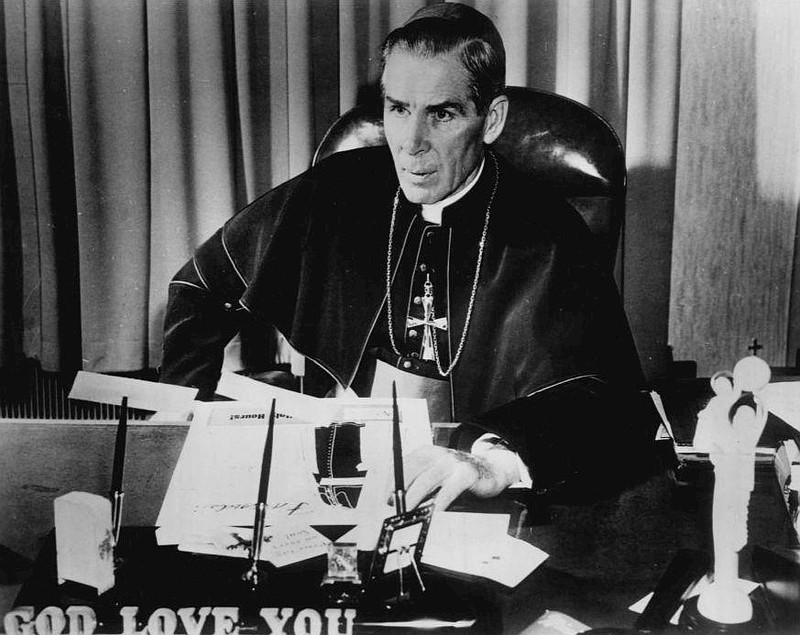
As a boy I recall him on television dressed in bishop’s garb and a pectoral cross given him by Pope Pius XII. His show was the first and only religious program to have corporate sponsorship. “Life is Worth Living” was a half-hour weekly lecture on God, Catholicism and various moral questions that managed to avoid proselytizing but also attracted over ten million viewers from different faith traditions. On his TV show, Sheen expanded on moral questions while keeping his talks generic enough to keep the non-Catholic viewer interested. His Irish wit – Oscar Wilde sans irreverence – was in stark contrast to the fiery fundamentalist preaching of Cape May’s Rev. Carl McIntire (1906–2002), who hated Sheen and Catholicism.
Sheen’s family was from a small town outside Dublin; they immigrated to the States during the Great Famine in the 1840s. They were mainly farmers. He was the eldest of four brothers. In high school classmates called Sheen “Spike” because he combed his hair straight back in a style known as the “pompadour.”
He was known as a meticulous dresser. As one of his classmates told Sheen biographer, Thomas C. Reeves, “His suit always looked neat as a pin and his hair was always in place.” Reeves goes on to write, “Perhaps this was the beginning of the vanity that would later emerge and admittedly be a serious personal problem.” As a student, Sheen had no interest in girls. He knew he was going to become a priest at a very young age. He was a spry 5’7” and weighed 115 pounds, so sports, except for handball, was out of the question.
After his ordination to the priesthood, he developed a reputation as a public speaker and as an author. At the time of his death in 1979 he had written over 70 books. Well-educated, handsome, and able to speak five languages, when he went to lead a retreat at the just established Rosemont College near Philadelphia, the nuns there thought he was an altar boy.
Soon he was lecturing in London and Oxford and teaching at the Catholic University of America (CUA), where he found the theology taught there less than satisfactory. He obtained two doctorates. Ambitious in a worldly sense, he was writing and publishing books but yet always took time out to curtail his pride in his achievements by visiting and praying at a women’s Carmelite monastery in Indiana.
In his sermons and talks, Sheen reiterated that, “The Catholic Church was the only institution standing between civilization and chaos.” He criticized Protestantism as being too “obsessed with economics, social service, humanism, and sociology,” things he felt were far away from “the spiritual side of the Father’s house.”
Why he appears to be a potential saint for our times has to do with his ability to deal with his wildcard fame on radio and television — “Life is Worth Living” was so popular it caused the cancellation of “The Frank Sinatra Show” on another network — without glossing over or “dumbing down” the tenets of Catholicism when it seemed that the Church in the 1960s was going in the other direction. His main fault in those years, as he stated in his autobiography, was his vanity regarding nice cars, clothes and clerical titles.
This brings us to the Second Vatican Council and Sheen’s thoughts on the Council. Initially, Sheen was enthusiastic about the Council — he was appointed to several Vatican II commissions by Pope Paul VI — and even wrote, “It is marvelous to be a part of the infallible Church teaching. I thank God I live in these times….It will be a different world at the end of the Council. The Spirit is everywhere over us, as at Pentecost.”
During the Council years he considered himself a member of the progressive wing of the Church. As Robert F. McNamara, United States secretary of defense from 1961 to 1968, commented, “His one constant fear was that Catholicism would be judged by other Americans as behind the times or irrelevant.” At the end of the Council, Sheen confessed to a friend that, “The faith of the Church is strong.” Ironically, the so-called springtime of the Church expected to follow the Council failed to appear. Instead, there was a sharp decline in the number of priests, religious and seminarians. The number of Catholic nuns fell from 39,400 in 1965 to 18,100 in 190. Simultaneously there was a radical drop in religious commitment among Catholic laity.
As Reeves writes, “As early as 1966, Sheen expressed unhappiness with English translations of the Gospels, the Mass and the Missal, thinking them designed to please the least literate of Catholics.”
By 1975, he was lamenting the high degree of liturgical experimentation happening in parishes throughout the world. What also upset him was the abandonment of habits by religious orders, especially nuns.
In 1976, Sheen wrote, “As the sense of the Sacred diminishes, Sisters in pants distribute communion, while priests sit idle in the sanctuary. This ‘option’ results from a decay of the reverence for the Lord’s presence.”
Sheen also criticized post Vatican II church architecture. “Today our architecture is flat, nothing but steel and glass, almost like a crackerbox. Why? Well, because our architectures have no spiritual message to convey.”
In another development, he was critical of modern theologians “who refused to discuss sin, repentance, hell and Satan.” Sheen insisted that “the demonic is always most powerful when he is denied.” He thought it dangerous that the Church was overemphasizing social problems. He was no fan of the progressive monk Thomas Merton and he called radical Swiss theologian Hans Kung an Arian.
Although his liberal side admitted there might someday be deaconesses in the Catholic Church, he decried the Catholic left for its insistence that women be priests: “If the Lord wanted women to be priests, He would have made His immaculate Virgin Mother a priest.”
He condemned the sexual revolution in the 1960s. “Sex in a human being is not the same as sex in a pig.” He said that hippies were trying to be monks without God.
While walking through the streets of Manhattan, Sheen often gave away one hundred dollar bills to needy people and to those who appeared homeless. One time in St. Patrick’s Cathedral, a homeless woman approached the high altar and began screaming at him. Sheen took her under his wing, somehow managed to get her to go to confession and attend Mass on a regular basis. He supported the woman for the rest of her life.
His struggles with New York’s Cardinal Francis Spellman proved to be a great challenge in his life. Initially great friends, as Sheen’s fame increased, largely as a result of his television program, issues developed between the two men regarding power and money that caused Spellman to use his influence to send Sheen sent into exile: Sheen was made Bishop of Rochester, New York, a no-win diocese for the prelate. The public was unaware of the animosity between the two men because Sheen never spilled the beans but kept his pain and suffering private, although he did tell a friend regarding his battles with Spellman, “Jealousy is the tribute mediocrity pays to genius.”
In the hospital after open-heart surgery in the late 1970s, Sheen said, “I was never afraid to die because God is with me…wherever I go. At no time did I have any fear.”
On the morning of December 9, 1979, the bishop was found dead inside his private New York apartment chapel. This was his wish: to die before the Blessed Sacrament.