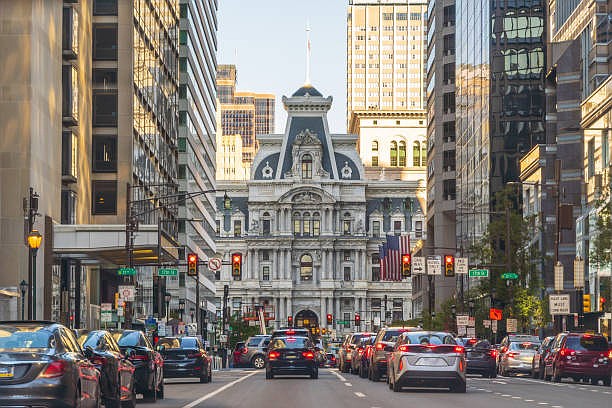
Philadelphia downtown city skyline. (Credit: Stock Image by IStock)
Unless you live under a rock or an I-95 overpass, you know the nation’s attention will be on Philadelphia throughout 2026. The events that mark this a defining year began earlier this month at the Xfinity Mobile Arena, where some of the open rounds of March Madness were held.
The momentum will build until this summer, when Philadelphia hosts six World Cup games and the MLB All-Star game. The marquee event is America’s semiquincentennial, where scores of tourists will celebrate our independence in America’s birthplace.
The City Controller’s Office estimates 1.5 million visitors will arrive over this time, representing “the largest concentration of visitors in the city’s history during a single period.”
Obviously, Philadelphia wants to make a good impression and has been preparing for this for years. Now that winter is over, street-level efforts to beautify the city will begin in the coming weeks.
A city derided for its filth may finally receive a much-needed cleanse. But if efforts are successful, some will raise the question of why Philadelphia cannot always purge itself of litter, graffiti, vagrants, and petty crime.
This is an understandable line of inquiry, but it lacks nuance. From households to multinational corporations, individuals and entities tend to put in effort to make themselves presentable to guests or when in the spotlight. Cities are no different.
After all, governments of all sizes can surge resources, especially when an event is scheduled or predictable. Maintaining such a high level of effort is not sustainable, since the manpower, funds, and equipment to make major events possible must return to their ordinary use eventually. Otherwise, different functions of government will eventually be neglected and funds will be depleted.
The proper question, then, is whether Philadelphia will commit the willpower to sustain any benefits gained during the preparation for these events. Some return to pre-2026 conditions will be understandable, but a complete reversion to the status quo is a choice. The goal is not perfection, but preservation of the most visible and meaningful improvements.
Analogizing the city to a household is useful here. Deep cleaning a house every spring or before hosting an event takes a lot of time, effort, and resources, especially if the household fails to keep up with regular chores and maintenance. Maintaining cleanliness after the fact is much easier, though it requires diligence.
The condition of Philadelphia after this summer’s highlights will be no different.
In the coming months, residents and regular visitors to Philadelphia should look for marked improvements in the city. If they arrive, as I suspect they will, the next question is whether these improvements are sustained or if Philadelphia succumbs to entropy and returns to its reputation of filth. If it does, people will know the city’s squalor is less a lack of resources and more a deficit of will.