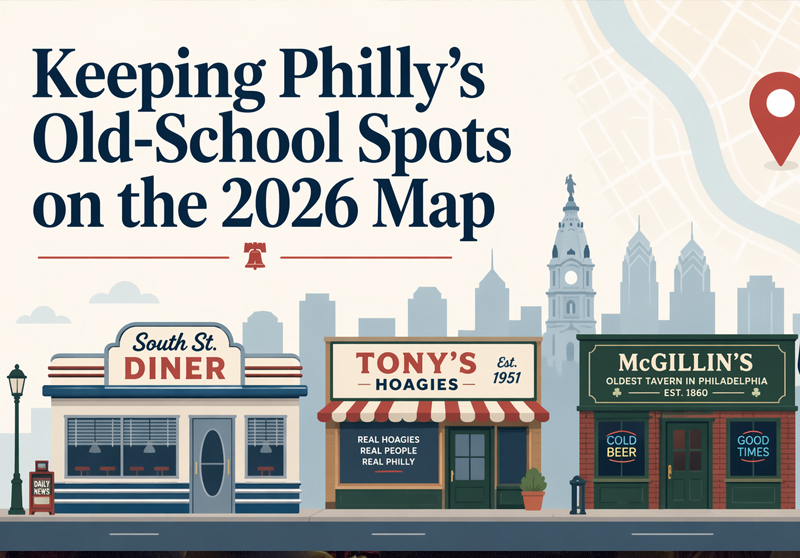
Philadelphia has always loved places with history. The corner tavern with a faded sign. The family-run sandwich shop that has done things the same way for thirty years. The South Philly red-gravy institution where everybody swears the sauce still tastes like childhood. These places are part of the city’s identity. They are not trends. They are landmarks.
But in 2026, being beloved by the block is no longer enough.
A business can have loyal regulars, a strong reputation, and a full story behind it, yet still lose customers every day because its online presence is sloppy, outdated, or scattered across the internet. One bad listing. One old phone number. One wrong closing time. That is all it takes to send a hungry customer somewhere else.
In the past, neighborhood buzz carried a business. Today, search visibility, map accuracy, and directory consistency are part of the same equation. The first impression often happens before anyone sees the front door. It happens on a phone screen.
When people talk about local search rankings, they are really talking about trust. Search engines want to feel confident that a business is real, active, and exactly where it says it is. That confidence comes from repeated signals across the web, including your business name, address, phone number, hours, categories, and website.
That is where Philadelphia local SEO citations come into play.
A citation is simply an online mention of a business’s core details. It might appear on Google Business Profile, Yelp, Apple Maps, TripAdvisor, Bing Places, local media sites, tourism directories, restaurant platforms, or neighborhood blogs. One mention is useful. Dozens of matching mentions send a much stronger signal. They tell Google and other platforms that this business belongs in local search results for that part of the city.
For legacy businesses in Philadelphia, this matters more than ever. Tourists search for the best roast pork near Center City. Temple students look for late-night food. Couples in Fishtown scan maps for cocktails, patios, and reservations. If your business information is inconsistent, you are making it harder for search engines to recommend you, and easier for customers to move on.
Philadelphia is not a city where people like to waste a trip. Parking is annoying. Weekend crowds are real. Weather changes fast. If someone travels across town because a listing says your kitchen stays open until midnight and they arrive to find it closed at ten, the frustration is immediate.
And that frustration does not stay private.
It becomes a one-star review, a complaint in a local Facebook group, a post in a neighborhood subreddit, or a bad impression that sticks. That is why business listings management is not just a technical detail. It is part of customer experience now.
For old-school spots, this can feel unfair. Owners are focused on staffing, ordering, rent, and keeping the quality where it should be. They are not sitting around wondering whether an old directory still has a number from 2019. But search engines notice that stuff. So do customers.
A restaurant does not need to become trendy to stay competitive. It just needs to be easy to find, easy to trust, and easy to visit.
Here is the good news. Philly’s independent businesses are not doomed to lose to chains and hospitality groups with bigger budgets.
In fact, local relevance is one of the few areas where smaller operators can still punch above their weight. Search engines are trying to connect users with the most accurate and useful nearby result. That means a neighborhood business with strong local listings, updated hours, relevant reviews, and location-specific authority can absolutely outrank a bigger brand.
That is especially true in a city as neighborhood-driven as Philadelphia. Search behavior here is hyper-local. People are not just searching “best restaurant.” They are searching for “best Italian in South Philly,” “brunch near Rittenhouse,” “bars in Manayunk,” or “cheesesteak open now near me.” When your local presence is clean, you stand a better shot at appearing in those map results.
And once you are visible, your real-world strengths take over. The atmosphere. The history. The food. The word of mouth. Digital discoverability gets the customer in the door. The business still has to earn the loyalty.
There is a certain kind of Philly business owner who hears all this and rolls their eyes. Fair enough. The city is full of places that survived long before algorithms became part of daily life.
But this is not about chasing some shiny marketing trend. It is about making sure the internet reflects reality. If your hours changed after the pandemic, that should be accurate everywhere. If you moved, rebranded, or changed your reservation link, that should be updated too. If articles, directories, and listings mention you in different ways, those loose ends should be cleaned up.
That is where broader digital marketing for restaurants comes in. Not the fake, flashy kind. The useful kind. The kind that helps a business show up correctly when someone is ready to spend money.
A lot of owners hear the word SEO and picture something abstract or manipulative. It does not have to be. Strong local optimization is usually basic, practical, and overdue. It overlaps with reputation management, review trust, map accuracy, and discovery. Call it SEO, call it visibility, call it onlinemarekting if you want. The point is simple. If people cannot reliably find you online, your offline reputation is not doing all the work it should.
Search is changing fast. More people are using voice assistants, AI summaries, map apps, and recommendation layers to decide where to go. They are not always scrolling through ten blue links anymore. Sometimes they ask a question and accept the first answer they get.
That raises the stakes for structured business data.
If your listings are fragmented, an AI-driven result may skip you entirely. If your profile is incomplete, you may lose out to a less interesting business that simply has better information online. That is the frustrating part. The best place is not always the place that gets shown first. Sometimes it is just the place with the cleanest digital footprint.
For Philadelphia businesses with real history, that should be a wake-up call. The city’s most memorable spots deserve to be discoverable. They should not fade from local search because of outdated citations, duplicate listings, or broken links.
There is something deeply Philadelphia about a business that sticks around. It means people kept showing up. It means the neighborhood kept believing in it. It means the place earned its place in the city.
That is exactly why Keeping Philly’s Old-School Spots on the 2026 Map matters. This is bigger than rankings. It is about preservation through visibility. It is about making sure the institutions that shaped the city do not get buried under cleaner profiles, stronger metadata, and better-managed competitors.
The businesses that built Philly’s character should not become invisible because nobody updated their digital storefront.
In 2026, a clear map listing is a form of curb appeal. Accurate local citations are a form of trust. And strong neighborhood visibility is no longer optional for businesses that want to stay part of the conversation. Philly’s classics already know how to earn loyalty. Now they need to make sure the next customer can actually find them.