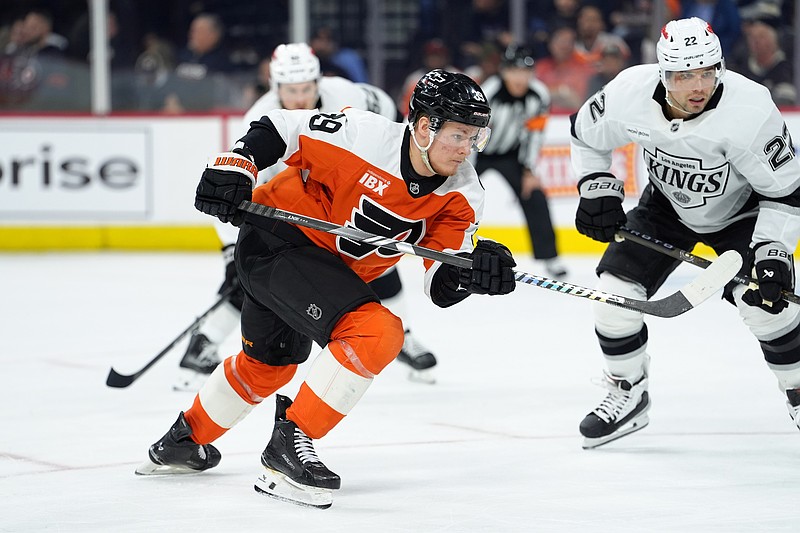
Jan 31, 2026; Philadelphia, Pennsylvania, USA; Philadelphia Flyers right wing Matvei Michkov (39) in action against the Los Angeles Kings in the second period at Xfinity Mobile Arena. Mandatory Credit: Kyle Ross-Imagn Images
There's been a lot of consternation amongst Flyers fans all season about Matvei Michkov's usage in games.
It was exacerbated over the last couple days after Michkov had only 10:21 of ice time on Saturday against Los Angeles.
On the surface, that number is too low for a player of Michkov's skill and ability. So, it's definitely worth questioning.
And when you look under the hood, you'll find that the answers to the question are pretty simple and sound, and is not a coaching malpractice as many would like to believe.
But before we get to the data, it should be known that Flyers coach Rick Tocchet did himself no favors when talking about this at the Flyers Carnival on Sunday.
Tocchet did the media rounds and stopped by several locations to talk about his team, and his most damning answer came when he was asked by Bill Matz of PHLY about it directly.
Rick Tocchet comments on Matvei Michkov's season low 10:21 TOI 👇 pic.twitter.com/u58CSTNNaw
Tocchet's response?
"Matvei did not come into camp in shape. It's hard to play yourself into shape," Tocchet said. "I have not told him or any other player 'take a guy one-on-one. Come out of the corner with the puck. On a rush, make a play with the rush.' He's having a tough time in those situations. So, other players try. Maybe they don't have the skillset. But we're trying to get him to that level. How to develop him. Practice. Making sure you are on time for treatments. There's so much into that. The way you eat. You don't become a star - and I'm not talking about that guy, I'm talking in general - any person, look at Trevor Zegras. He had a couple bad years. He comes here, bought into a couple things and, you know, he's doing a hell of a job for us. He's in a little bit of a slump and we're trying to get him through the center position. I think this is the time to try it. Whether he can do it or not, we'll see. But, I don't know if I've answered the question but that's kind of the rules of winning. The crest supersedes everything. Not individuals. That's how I believe."
Tocchet is media savvy, but saying it in this way was a misstep. He's not wrong with what he's saying. But using that as an answer about Michkov's ice time is not the right way to go, and only fuels the voracity of the anger coming back at him from the fans.
It makes it seem like he's purposely holding Michkov back on the ice, which as you'll see shortly, isn't really the case. However Tocchet is likely tired of all the conversation around Michkov and letting the emotions of the persistence of that conversation get the better of him. He's an emotional guy, and honest, sometimes to a fault - like the comment above.
It's funny, because we hate coaches who tell us nothing, talk in cliched coach speak, and demand more honesty and transparency, but then when we get it in excess, we get mad that there's too much dirty laundry being aired.
And while a happy medium would be the best mix in these cases, we have to understand that athletes and coaches aren't necessarily trained orators and they aren't always going to get it right in an interview and they need some grace with that.
But Tocchet should know better in this case. This isn't something that just popped up on Sunday. This has been an ongoing issue since October. And with Michkov not being able to really answer for himself because of a language barrier and his translator not available presently (something for which the Flyers should have had a contingency plan in place), being able to tell the temperature in the room should have required a more measured response to questions about the 21-year-old winger.
Have talking points. Have data to support them. It's O.K. to say he's working through tough times and working to become a better player, but rather than talk about being late for treatments or that he isn't eating right or hint that he's not a team-first guy at the end of the quote, explain how there's nothing punitive about his ice time - because there's not. There needs to be better coordination internally on public messaging. Too often they miss the boat here.
But let's get down to the nitty gritty about Michkov's ice time.
First and foremost, let's look at the season as a whole, before we get into Saturday specifically.
For the season, Michkov averages 14:32 of ice time per game, which is a lower number than one would expect. But, for the season he's average 19.6 shift per game. If a player is taking 20 shifts in a game it usually translates closer to 17 minutes of ice time. So, Michkov's shifts are short.
Yet, by comparison, Michkov's 19.6 shifts per game rank seventh on the team among forwards. Again, you could say he should be higher. But let's look at who is in front of him:
Centers are always going to have a higher average number of shifts, mostly because they take faceoffs, and sometimes an extra center will replace a winger on the ice for key draws because coaches want two potential faceoff guys. That and each of the guys who have played at center all season - Couturier, Cates and Dvorak - also kill penalties. So does Konecny. Michkov does not. So, there are always extra shifts these guys are getting every game that Michkov doesn't when the Flyers are shorthanded.
Konecny is an all situations winger - and the team's leading scorer. Which is why he is on the ice for the most shifts.
Zegras has now shifted back to center, but he was arguably the Flyers best offensive player in the first half of the season, so it shouldn't surprise that he has an extra shift or two.
So really, it comes down to Michkov vs. Tippett as far as players who have similar roles and expectations. and the difference is 1-2 shifts per game. It's clearly negligible and hard to argue that Tippett should see fewer shifts than Michkov this season considering how both have played.
Therefore, Michkov is getting his shifts, and regularly. The only time, it seems, the coaches make a cognizant effort to not use Michkov is early in overtime. They haven't said anything publicly, but with overtime being all about possession, and Michkov still dealing with turnover issues, they feel it's safer to deploy him later in overtime, when they have clear possession, there's an actual change on the fly, and they might be able to catch tired defenders on the ice. They'd rather that than for the start of a shift on a faceoff where possession is 50/50 and they don't want to risk him getting caught out there where he has to defend for longer shifts.
And that brings us to Saturday.
Why did Matvei Michkov only play 10 minutes today? https://t.co/5S99rQ6zHy pic.twitter.com/wpOrGv1p6Y
Michkov played only 10:41. But he had 18 shifts. That was about two shifts fewer than average - and we'll get to those two shifts in a moment, because they were situational - so why then was he four minutes below his season average in time on ice if it was just two shifts?
Because he is coming off the ice early on his shifts.
Now, sometimes, line changes will happen after a stoppage in play after a shorter shift. The threshold for coaches for an even strength shift as far as making a change after a stoppage is usually about 30 seconds. If you had been on the ice for 30 seconds already, you're going to have a short shift and a line change is coming. Every coach will tell you that. Additionally, especially when a team is playing at home, a line change could occur based on matchups. Who is the other team putting on the ice and what line do we want against that line? Also, where is the ensuing faceoff occurring? Those decisions are part of every hockey game and are absolutely coaching decisions, but are certainly understandable in how they are handled.
The rest of the time, a player coming off the ice after a shift is based on when the player feels his tank emptying.
Coaches tell players to go out on the ice and bust it for anywhere from 35-50 seconds and then change. As games move along, shifts tend to be shorter as players bodies start to tire. That's why you will frequently see shorter shifts in the third period and overtime than you do in the first period.
On Saturday, after two periods, Michkov had 13 shifts -- the same as linemate Bobby Brink -- and nine of those shifts were more than 40 seconds, according to ShiftChart. In the third period, Michkov had five shifts. Four of them were less than 40 seconds.
He is changing when his body is telling him to change - and later in games, he's feeling the need to change sooner, shortening his shifts, and ultimately impacting his overall time on ice.
He took two fewer shifts in that period because both were faceoffs on the Flyers side of center ice and Tocchet wanted two centers on the ice for draws in a tie game. Had the Flyers been behind or ahead by more than a goal, MIchkov is probably on the ice for these shifts. Instead, Couturier took those shifts with Zegras and Brink.
One could argue that they'd rather Michkov on the ice than Brink, and it's certainly a good conversation to have, but in tight games, especially a tie game later in regulation, coaches are going to err on the side of defense - after all they want to at least get one point in the game - and rather than risk missing out on at least one point while going for the win in regulation, they are more conservative. Just look at the percentage of games that have gone to overtime in the NHL this season to see that isn't just a Flyers philosophy, but the way it is in the sport.
Ergo, Brink is the best defensive forward on the line with Zegras and Michkov, so he wins out on being on the ice and Michkov is on the bench for those faceoffs.
While it's still likely fans would be upset with the team in general, an explanation about Michkov's ice time centered around the data, and not an airing of internal frustrations, would have gone over much more smoothly.
Instead, the Flyers are left dealing with unwanted external vitriol, and they find themselves at the bottom of a six foot hole with just a few shovels. The trick now is to figure out how to use them to climb out of the hole rather then allow the dirt to cave in on their own graves.
Understanding that while the criticism of Michkov might be warranted, it was wrong to do it publicly to a fan base that is so bought into his future, in the aftermath of losing 11 of 13 and without actual context, might be the first step in getting it right.