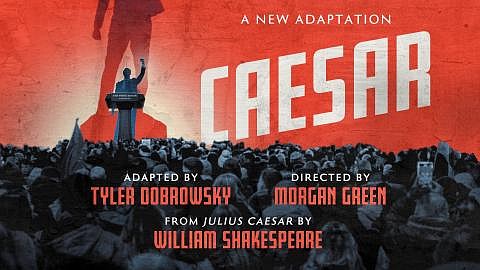
The Philadelphia Theatre Company’s latest production, “Caesar,” as adapted by Tyler Dobrowsky, Co-Artistic Director of PTC, contains sections of the Shakespeare original while it embraces – as Dobrowsky writes in the play’s program notes – “contemporary tools – video, projection, screens – not to modernize the play superficially, but to reflect how power, persuasion, and image-making operate both in the play and in our current political climate.”
Dobrowsky’s version focuses on four Roman figures – Brutus, Cassius, Marc Antony and Caesar, whose political choices “propel Rome toward civil war.”
There’s a lot of blood in this play, especially when Caesar — dictator or would-be dictator, depending on your point of view — is assassinated. As anyone who has ever read Robert Graves’s 1934 historical novel I Claudius knows, the Roman Empire was rife with small revolutions and assassination plots, with mother plotting against son, son against father. Few could be trusted in what seemed like an eternal cavalcade of terror. Self-proclaimed tyrant haters killed tyrants, only to become tyrants themselves.
Dobrowsky notes that “this production is not as interested in one-to-one political allegory.” He cites Oskar Eustis’s “two landmark interpretations, one which posited Caesar as a JFK-like figure, the other as a MAGA-hat wearing Trump stand-in.”
There are no direct references to Donald Trump in the play aside from a quick video clip from January 6, a visual that is rendered powerless because of the overlay of other videos depicting revolutions, revolts, protests and world wars. The video juxtapositions depict all kinds of uprisings, from the right and the left. Tyrants transcend party affiliation despite the fact that at any given time at least half the population is going to view a supposed tyrant as a savior.
Dobrowsky deserves credit for staying away from the MAGA-equals-boogeyman equation, which would be so easy to do in the left-leaning Philly theater world. The MAGA-as-tyrant approach would have dumbed down the play to propaganda. The existential approach the play takes is simple yet intricate: power corrupts — all power, whether it’s Biden on the edge of dementia having his staff auto-pen executive orders, Trump on a bad day, or Abraham Lincoln when he significantly expanded presidential war powers, suspended habeas corpus and authorized military arrests without Congress's initial approval.
In an interview with a student blogger named Brianna Arie in “Broadway Forum,” Dobrowsky stated the play was not trying to say, “Caesar is this current president or former president….I think it's trying to get you to think about some of the deeper ideas that are inside the play…. the play could be about how these evil senators killed the good Caesar. Or it could be about how these really righteous, good senators killed the evil, autocratic, wannabe dictator Caesar. You don't have to do that much to shift [Caesar] like that. So, that's what I kind of love about it. It's a play that you can do in so many different ways.”
Caesar, played by Jude Sandy, is a black man — this alone squashes superficial Donald Trump comparisons — with extensive Broadway/Lincoln Center experience. The Caesar he plays is not a scary, out-of-control Caesar but presents as mostly good-natured, somewhat frivolous, and a little narcissistic (he’d rate a 10 on the looksmaxxing scale).
Brutus, played by Matteo Scammell — a Barrymore Award winner who has done work with the Ardan Theatre Company and Wilma Hothouse — is a natural Alpha warrior type, emotionally cold but an expert at flattery as he plots with his Beta companion, Cassius (played by J. Hernandez, who’s worked with Theatre Exile and Quintessence ), an excessive talker who wears his emotions on his sleeve and who follows Brutus around like a stray pup.
Cassius and Brutus share a love beyond ordinary friendship that comes close to suggesting aspects of classical Greco-Roman homosexuality, although that’s left to our imagination.
Unfortunately, why Caesar is so hated and why he has to be assassinated is never fully explained other than the fact that his assassins and others fear he may want to crown himself king. Ironically, Caesar has already refused the crown but the assassins don’t trust his refusal. Perhaps he’s just the guy in power who has to be gotten rid of because the human thirst for revolution is endless.
Director Morgan Green writes in her “Director’s Notes,” that the play’s “emotional logic feels modern.” She adds: “We often found ourselves laughing and crying in rehearsal, relating deeply to the characters’ experiences of love, hope and pain…. Though this play contains some of Shakespeare’s most famous lines, it ends in a battlefield depicted here through Jungwoong Kim’s ethereal physical vocabulary….”
This choreography of war (the play has no intermission) happens in the latter section where the male characters wage battle, fall down, roll around, and then come together in a (heavy breathing) orgiastic human mountain of arms entwined with arms, faces meshed with faces, and legs wrapped around the whole ensemble as the men “pulsate” on stage for quite some time.
This part really goes on far too long and could have been shortened to increase its effectiveness.
The actual Caesar assassination is rendered in a realistic way: Jude Sandy really knows how to depict a dying man who has just been stabbed several times, especially when we hear the gurgling sounds he makes from his throat. This death pang is all too real. The assassins then take a blood oath after they dip their hands into a small fountain filled with Caesar’s blood.
And this is where things get messy.
Marc Antony (Jaime Maseda, who’s performed with Pig Iron, the Wilma and Off-Broadway), a friend of Caesar’s, walks in one the killing scene and then has to make his peace with the assassins although he’s fast to betray them with a plot of his own. His performance is stellar. He’s able to show the tension of placating power while secretly orchestrating his own revolution.
He bides his time, then strikes.
The result is another cavalcade of terror: Get rid of one dictator and another takes his place. Civil war follows the assassination as Marc Antony takes the no. 1 power spot, but the clock is ticking.
The acting in Caesar is impeccable, but the war choreography where soldiers “dance” and fall down in battle, rolling this way and that in a kind of ballet of death, calls for a dramaturge.
As Jungwoong Kim, the play’s choreographer notes: “Characters dissolve into faceless bodies moving through space…. The result is operatic and relentless – figures eternally grasping, clawing and striving until the bitter end.”
Postscript: The day after I saw the play I ran into actor William Rahill in my local supermarket. Rahill started talking about “Caesar” and the fact that a good female friend of his was responsible for cleaning up the blood on stage after each performance. He told me, “You can imagine the work involved in that!”
“I’m looking for some food to bring her when I go to the theater,” he added.
With all that blood, you need food.