Library of Congress
I found it perversely entertaining the other day to watch shrieking she-devil Pam Bondi as she sought to defend her dirtbag tenure at the Department of Pedophile Protection. She makes the Wicked Witch of the West look like Mother Teresa; any second I expected her to vow vengeance against her congressional inquisitors, a la “I’ll get you and your little dog too,” in the service of her MAGA-cult quest to run Justice as a criminal defense firm for rich and powerful perverts.
And at several points - when she lied at a high decibel that her Sun God had been “overwhelmingly” elected; when she screeched that Jeffrey Epstein’s sexual assault survivors were less important than the stock market (“The Dow is over 50,000 dollars!”) - I suddenly found myself pining for the likes of Janet Reno.
Now you’re thinking: Janet Reno?!
Trust me, you want to hear about Reno. It’s a new way to assess Bondi.
Nostalgia is a Greek word, coined in the 17th century from nóstos ("homecoming") and álgos ("pain" or "longing"), but while I’m by no means longing for the 1990s, I think it’s useful to revisit Reno’s eight-year stint as Bill Clinton’s Attorney General - if only to contrast it with Bondi’s fascist freak show, and to remind us what it was like to have a Justice leader who didn’t make it her mission in life to kiss the tush of the alpha dog.
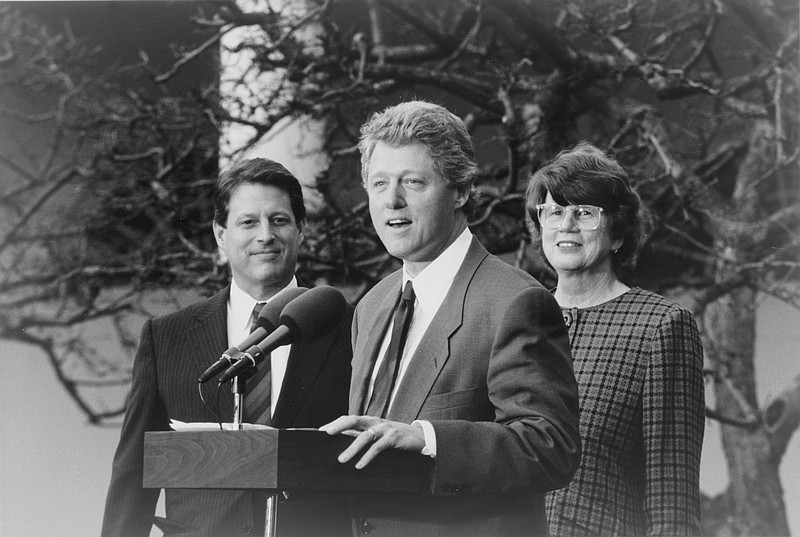
If you know or remember anything about Reno, chances are it was her stolidity and six-foot-one stature as satirized in “Janet Reno’s Dance Party” on Saturday Night Live. They made fun of her serious mien - but that was her superpower. On the job she was so serious about protecting Justice’s independence from White House interference and influence that - get this! - she rarely even spoke with the president who appointed her. And vice versa.
Imagine such a thing. Unlike Bondi, who’s chained by choice to Jabba the Hut, Reno was so conscientiously distant from Bill Clinton that his aides nicknamed her the Martian. Not only did Reno refuse to take orders from Clinton, not only did she announce policy decisions without clearing them with Clinton, she also seemed not to care what he thought of her. Reporters back in the day wrote that she was “indifferent to the judgment of others,” and that, in the words of former top deputy Walter Dellinger, she was “not driven by the need for approval.”
Reno wasn’t perfect, of course; like most AGs, she took heat from all sides for a string of hot-button decisions. In 1993 she OKed an FBI raid of a religious cult compound in Waco, Texas, which ended when a fire killed nearly 80 people, including kids. In 2000 she ordered federal agents to forcibly remove six-year-old refugee Elián González from his relatives’ home in Miami and return the boy to his dad in communist Cuba, a decision that infuriated Republicans.
But ponder this key factoid:
Reno pissed off Clinton by appointing five independent counsels to investigate people in his own Cabinet - and, most famously, to investigate him.
When asked once why she became a lawyer, Reno replied: “I didn’t want people to tell me what to do.” That clearly included the president who hired her. And while testifying on Capitol Hill (without trash talk), Reno defended her use of special counsels: “There is an inherent conflict whenever senior executive branch officials are to be investigated by the (Justice) department and its appointed head, the Attorney General…Public support for our government is predicated on the belief that the government is fair and just.”
Give that last sentence a second read. Feeling nostalgic yet?
Reno green-lit special counsel probes of four Clinton Cabinet members (Mike Espy, Ron Brown, Alexis Herman, Henry Cisneros), and she triggered the probe of Bill and Hillary’s roles in the failed Arkansas land deal known as Whitewater. That was a penny-ante scandal (there was no evidence of Clinton criminality), but the special counsel who ran that probe - a guy named Kenneth Starr - stayed on the job long enough to latch onto the Monica Lewinsky sex saga. And we know how that went.
Clinton wanted to dump Reno at the start of his second term and install a friendlier AG; by all accounts, he let it be known after his ‘96 reelection that he wanted her to go. But - believe it or not, this really happened - she announced that she was staying. And Clinton decided it wasn’t worth a political kerfuffle to force her out. He didn’t want people to think or perceive that he was putting his thumb on the scales of justice.
Instead he quietly seethed, especially about his friend Henry Cisneros. Reno targeted Cisneros for special treatment just because he’d allegedly made false statements to the FBI during a routine background check about some money he’d paid to an ex-girlfriend. Compared to the unprecedented corruption and coverups that Bondi aids and abets, Cisneros’s alleged misdeeds barely register as a parking ticket. Yet he was put through the wringer. Reno’s special counsel spent four years on that case, just to have Cisneros plead guilty to a misdemeanor.
OK, so maybe Reno was a tad too vigilant at times. But just imagine how she would’ve dealt with overwhelming evidence that rich brutes had serially raped underage girls. If an AG with Reno’s moral compass was on the job today, and the sitting president was raking in money from the crypto industry, there’s no way that such a person would’ve fired most of the Justice Department’s cryptocurrency enforcement team. Bondi has already done the deed.
But here’s the starkest contrast between Reno’s era and our current dystopia: Clinton appointed a strong, independent woman who charted her own course with a moral compass - whereas Trump did the opposite. Bondi, in the words of ex-Republican strategist Steve Schmidt, personifies “how Donald likes his women: cheap, plastic and servile.”
She is programmed for mindless servility; that’s not how her department is supposed to function. If we do manage to survive this era, Justice will need to reclaim its mission of prosecuting without fear or favor. It should channel Janet Reno’s independent spirit to dispel the stink of MAGA fascism. That would go a long way toward re-balancing the scales.