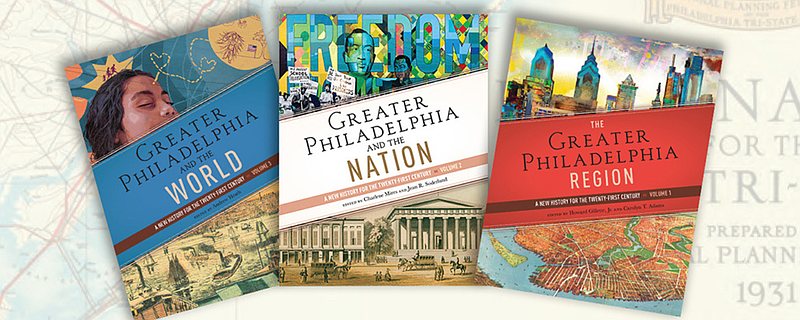
It’s the Atlas Shrugged of regional history books. “Greater Philadelphia: A New History for the Twenty-First Century,” a three-volume set, is heavier than a large piece of concrete you might find near Graffiti Pier along the Delaware.
I was looking forward to receiving this triad of “Philadelphia Everything,” from the historic to the downright frivolous. Looking at the covers of the books, the expensively bound volumes with quality paper nevertheless struck me as decidedly “Middle School.” The textbook-like design of the covers is probably the result of having been published by the University of Pennsylvania. The covers suggest the history presented has been screened, filtered and analyzed by people – in this case academics – who know how to ‘mainstream’ and market facts while also giving the text a slight “Peoples History of the United States” slant.
Meaning, these books have a liberal bias. I picked a certain section at random in volume 1 and came upon a large photo of the Congress of Racial Equality. Volume 1 also offers sections on the Lehigh Valley and what seemed to me like a stretch, the New Jersey Pine Barrens (but with no mention of the Jersey Devil.) There’s also a photograph of hundreds of all-white commuters — taken in 1970 — crowding around the turnstiles at the 69th Street Station.
The volumes are replete with beautiful photographs, maps and illustrations.
We read of the Lenape, the Cohanzicks and the Mantes tribes and how the Mantes built towns along Delaware Bay. We learn that in 1600 the Lenapes numbered about 75,000 people but by 1650 those numbers dropped to 4,000 and then 3,000 in 1670. We learn – what most of us have always known – that the Delaware Natives believed in a Master Spirit and that those spirits inhabited the natural world: animals, rocks, plants and even clouds had accompanying spirits. We are reminded that the Dutch-Indian wars were over trade.
The first volume quickly passes into contemporary history when it touches on South Philly, the Italian Market, and the mural of Frank Rizzo that was removed and painted over by an anti-historical city order on June 7, 2020. That’s when the George Floyd riots had us on the edge of our seats wondering if and when our neighborhoods would be blown up. Those riots proved the perfect catalyst for everything anti-Rizzo (besides destroying the only McDonalds in Center City near Rittenhouse Square). Not only the Rizzo mural but the statue of the ex-mayor in front of the Municipal Services Building was desecrated by paint, a woman’s panties and bra, and eventually an official toppling or removal by a city intent on proving its leftist credentials.
It was a despicable era, but the whipped cream on top was Covid and a political lockdown that proved most people deferred to government control and willingly gave up their freedoms, as in standing six feet apart on subway platforms and yelling at anyone who didn’t comply.
A section on transportation and the Red Arrow Lines (1936-70) interested me, especially the Red Arrow’s Liberty Lines, a luxury train with a refreshment lounge and “soft music piped into passenger cars.” These extraordinarily handsome trains fell by the wayside when utility won over aesthetics and the new transportation model was producing boxy engines that mimic refrigerators. I must confess whenever I read about the Red Arrow Lines my mind goes back to the death of my paternal grandmother and her sister when both were killed by a Red Arrow trolley on my fifth birthday somewhere near Lansdowne when their car was hit by a trolley at a crossing station. Perhaps someday I will no longer equate Red Arrow with death.
A photograph entitled, “The Bustle of 69th Street, 1978,” compliments the 1970 commuter photo though it shows the town itself before its fall from grace. In the 1950s and ‘60s a mammoth white Easter Bunny statue was erected before the terminal; not far away was a walk-thru Old Lady and the Shoe, where children got to walk inside a super large replica of the shoe adapted from the 1875 German Fairy Tale by Joseph Martin Kronheim, “The Little Old Woman Who Lived in a Shoe.”
In Volume 2, “Greater Philadelphia and the Nation,” we learn of “freedom seekers,” such as how the Congress of Racial Equality activists organized and then posed for a photo around the base of the Liberty Bell (1963), a time when you could run your fingers inside the bell’s crack and touch it anyway you wanted. It is interesting to note that most contributors to these volumes use the term “African American,” and not the current preferred term, “black” – when referring to the city’s enslaved population.
During the Revolution many enslaved African Americans gave their support to the Loyalist side because the Loyalists offered freedom for military service. At least 20,000 slaves escaped to British lines, the book tells us, in order to gain that freedom. Quakers and Germans were mostly neutral or Loyalists although the Quakers supported resistance (as they do today when it comes to President Trump), but changed their tune as “colonel protests grew more violent.”
The disastrous Bicentennial of 1976, especially the Chestnut Street Transitway when it was devoid of cars but decorated with Grimm’s Fairy Tale like arches and wooden benches subject to weather rot, looked good for about ten months after construction. Even sparkling new, the $50 million project screamed ticky-tacky on many levels. As it aged it became a microcosm of urban plight, assorted winos and so called “bag people,” precursors to today’s homeless. A large — and quite beautiful looking on paper — expo center at 30th Street Station was sadly never realized. City Planner Edmund Bacon’s original plan for the Bicentennial was largely pushed aside by a group of architects and early woke reformers known as the “Young Professionals,” who wanted something low-cost with different scattered sites throughout the city that would highlight “the racial and ethnic diversity of Philadelphia.”
Protest movements of many kinds, from the fiery wars between Catholics and Protestants, the Girard College desegregation movement in 1965, the rise of Black Power and the Nation of Islam, the Annual Reminder at Independence Hall, Gay Power, Maggie Kuhn and the Gray Panthers, Occupy Philadelphia and Black Lives Matter, are covered in detail. I was unable to find an entry for MOVE, whose history is often sanitized by progressive revisionist “scholars” who somehow don’t know that MOVE was loathed by the majority of black Philadelphians.
In Volume 3, Greater Philadelphia and the World, the narrative covers abolition and immigration. We learn that the immigrant Irish gravitated toward the Democratic Party “due to the hostility of prominent Democrats like Andrew Jackson toward Britain. “
“The frequency with which Irish Catholics participated in anti-abolitionist violence owed something to their equation of abolitionists with support for the British Crown.”
Germans largely backed the new anti-slavery Republican Party in the 1850s.
From there we go to scrapple and learn that the meat is “A loaf of pig parts thickened with cornmeal or buckwheat usually spiced with sage and pepper,” and dates to the 16th Century, Germany.
These volumes are really wonderful in many ways if you don’t mind the occasional virtue signaling.
Where else would you get the history of Tastykake, Geno’s cheese steaks, or the Odeune Festival (founded in 1975), which was always a disaster for the neighborhood around 20th and Lombard Streets in the 1990s when revelers would destroy or pick the locks of several businesses. Let’s also not forget the Mummers, started in 1901, and its journey into the modern era when “reports of individual marchers using racist and homophobic slurs along the parade route complicated efforts to make the Mummers parade more inclusive.”
While much of that inclusiveness was a good thing, what emerged was a ridiculous dark side as well, as lefty parade fanatics began to obsess on the ethical “illegality” of non-Native Americans wearing Indian headdresses as they marched up Broad Street.
One more thing: Ira Einhorn, no Philadelphia hero by any means, gets a picture and a mention in regard to Earth Day 1970, while the woman he killed (Holly Maddux) is left nameless and referred to only as “his girlfriend.”