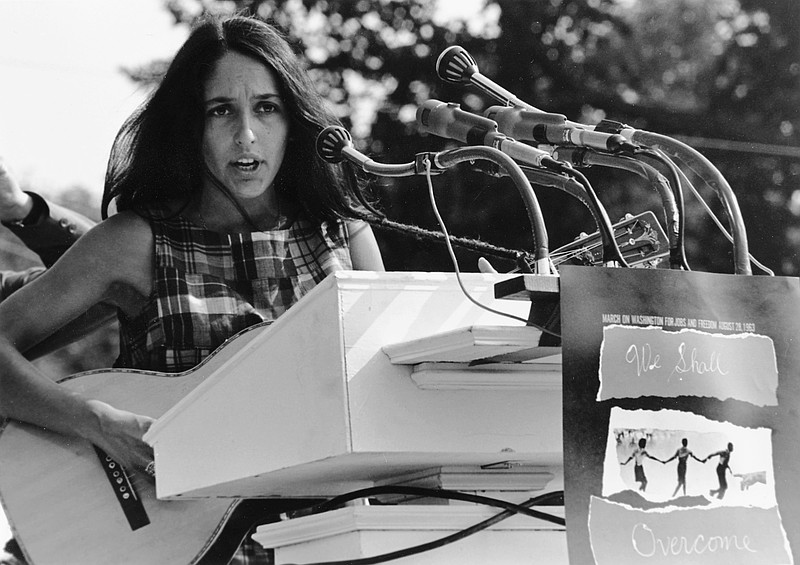
Joan Baez playing at the March on Washington in August 1963. Photo by Rowland Scherman, U.S. Information Agency
This year, folk singing legend Joan Baez turned 85. Six decades of social activism and singing frame her as unique in the musical history world.
Her political protests began with the Vietnam War and the Vietnam Draft Resistance Movement. She married folksinger David Harris – who died at 76 in 2023 – in 1968. Harris opted for prison rather than acceding to the military draft.
Over the years, Baez has been involved in every protest group and movement imaginable. Unlike some left-wing activists of the period, she never “grew” and switched political ideologies in later years.
(One thinks of the quote attributed to Winston Churchill: “If you're not a liberal at 25 you have no heart. If you're not a conservative at 35 you have no brain.”)
Certainly Baez has a brain but her political views lately have been disappointing.
Here’s Baez on America under Trump: “It feels like torn fabric.” Then there’s this 2025 quote: “The U.S. is headed for a military dictatorship.” That same year she told Variety that “Incompetent billionaires are running America.”
Joan Baez, the music legend, hit the Cambridge, Massachusetts, folk scene when she made the round of cafes there in 1960. Cambridge, the Berkeley of the East Coast because Harvard University is located there, is a culturally rich enclave of intellectual left progressivism. You’ll find few if any conservatives in Cambridge; this was especially true in the 1960s.
Born Joan Chandos Baez to a Mexican father and Scottish mother, Baez lived in Palo Alto, California, with her family until 1958 when her father, Albert, joined the faculty at MIT. The religiously diverse Baez family — her grandfather was a Catholic turned Methodist, while her mother was the daughter of an Anglican priest — converted to Quakerism while Joan was still a child.
Quakerism, with its left-progressive secular theology, helped mold Joan into what she would later become: an activist who spoke out on behalf of non-violence, civil rights and opposition to the Vietnam War. Baez’s first public act of civil disobedience was her refusal to leave her Palo Alto high school for an air raid drill.
The Palo Alto Times reported on February 7, 1958, that “Miss Baez stayed at the school until the normal end of classes at 3 p.m. She told school officials that she is a ‘conscientious objector’ and does not believe in the drill.
“Later in the afternoon she told the Times: ‘I don’t see any sense in having an air raid drill. I don’t think it’s a method of defense. Our only defense is peace.’
“She said she did not see any sense in a two-hour warning system when a missile can get to this country in half an hour.”
Fast forward to Club 47 in Cambridge and Baez’s first concert where she sang English murder ballads and Appalachian love dirges. Her mellifluous soprano voice caught on. She introduced audiences to Bob Dylan, and the rest is history.
When Baez was invited to sign her first recording contract with Columbia, she went into the posh corporate Columbia offices and immediately felt sick. What to do? She headed over to an independent label, Vanguard, where she signed a deal in 1960. Vanguard, she said, made her “feel safe.”
After she became famous, she refused a ride in a Cadillac limousine, calling it too capitalist, but when a truck was sent to pick her up, she reconsidered. “Maybe a limousine isn’t too bad.”
When I interviewed Baez by phone in the 1990s for a Philadelphia magazine, I was mostly charmed by her stories, many of them personal, but there was little of the political in our conversation. She talked about a gay nephew but not about her own bisexuality. She was adamant when she told me she was “over” voting in presidential elections. “Every four years!” she said with a disapproving sigh. The inference I got was that she’d become apolitical when it came to elections. By then of course, the robust activism of the 1960s and 70s had long passed, and Baez, the troubadour-activist, had been mostly silent when it came to “issues.”
She had also cut her epic long hair and now had a stylized helmet-feminist cut reminiscent of a zillion and a half suburban women – the kind of women who get in their lush SUVs and challenge ICE raids.
In 2026, she now spends most of her political ammunition supporting undocumented immigrants, using her music and platform to challenge “oppression” and inspire change globally.
In the mid-1990s when I interviewed her, it seemed she lacked a viable protest movement to join. When she talked of protest then it was only about the issues of the past.
The Christian Science Monitor summed up the mid-1990s in a September 1995 article, stating that:
“…By 1990, both '70s-style liberalism and '80s-style conservatism had failed. Unfortunately, no new political force within or outside of the two parties, representing ideas of the 1990s, has appeared. The result is an American electorate that tries to change the channel every few years — and finds nothing but reruns….”
Then came cancel culture and the extreme leftward turn of the Democratic party. The Monitor’s view that in the 1990s, “no new political force within or outside of the two parties…has appeared” was rendered null and void. The times they were a-changing….The Democratic party had become the counterculture on Marxist steroids.
Suddenly, Joan Baez re-emerged, the soprano phoenix having waited out the intervening years in relative “activist” obscurity.
Certainly, there had been nothing as newsworthy as her 1963 singing of “We Shall Overcome” at the March on Washington where Martin Luther King, Jr. delivered his famous “I have a dream” speech.
There were also no New York Times photo ops as grand as the image of her holding hands with King as the two escorted schoolchildren into a desegregated school in Grenada, Mississippi.
In April 1993, Baez did manage to travel to Sarajevo to give a concert as a way to show her support for the people there. The Baez website will tell you that she spent “eleven days running in and out of shelters” as bombs fell, although writer Susan Sontag, in a merciless dig and who was in Sarajevo at the same time staging a Samuel Beckett play, writes that Baez left the city in a terrified panic as soon as the first bomb exploded.
Donald Trump’s election in 2016 reactivated Joan Baez’s activism.
Baez, despite her reputation for humane disagreement and empathic understanding of “one’s enemies,” fell into all the leftist traps: Trump was a white supremacist, anti LGBT, anti-immigrant, anti-Muslim. Racism was also a national pandemic and it was destroying the United States from within, etcetera.
I was embarrassed for my former “hero.”
Yet even an icon can fall from grace.
Yet there was nothing from Baez when it came to cancel culture. Nothing about conservative thinkers and writers being banned from American campuses; nothing about the anarchists who burned down cities in the U.S. in 2020 to the tune of two billion dollars in damages; nothing about the toppling of statues of historic figures because they were perceived as having the wrong opinions; nothing about the illogic of biological men competing in women’s sports.
She did begin a secondary career as a portrait painter, capturing the likeness of Patti Smith, Stacey Walker, Greta Thunberg, Bernie Sanders and Ukraine President Zelensky. These unframed prints, signed and numbered, go for upwards of $350. She calls the series portraits of people “changing the world.”
Even more astonishing was her reference to her portrait of Zelensky, where she wrote: “Joan Baez never imagined painting a portrait of a war hero.”
While doing research for this piece I happened to notice that this year Joan will be doing a benefit-tribute concert for Taj Mahal in San Francisco. This caught my eye because in 1972 as an 18-year old bellhop in Boulder, Colorado’s Harvest House Hotel, the drummer for Taj Mahal called me to his room and asked me to do him a favor and pick up some shaving cream and a razor at a nearby convenience store.
Dutiful bellhop that I was, I made sure I the drummer got his wet shaving supplies.