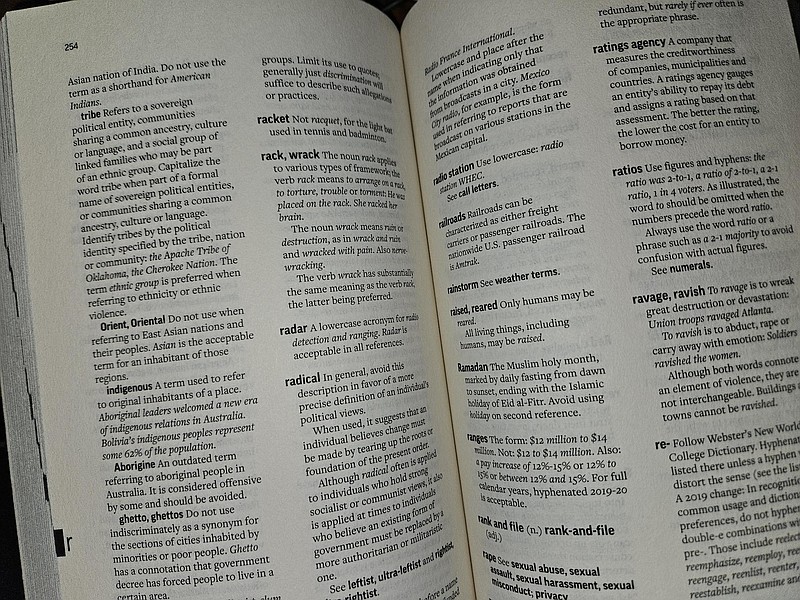
There was no AP Style book when I was in journalism school, but there was an AP satellite office next to the city’s Greyhound Bus station not far from City Hall.
With floor-to-ceiling windows sans blinds or curtains, passersby had a good view into the workings of what was then an outpost for mainstream breaking news: mostly men (with their shirt sleeves rolled up) standing around a battery of small teletype machines and typewriters. Whizzing by during my frequent trips downtown, I’d survey this fishbowl of journalism and wonder why it was located just a few feet from the bus terminal men’s room where there were vice cops waiting to bust men standing too long at the urinals.
The royal flush — or the connection between the AP and the left’s rewrite of the English language — would become evident years later after the first publication of the AP Stylebook in 1977. In those days, the AP Stylebook was known primarily as a grammatical and punctuation guide, the journalism equivalent to the Chicago Manual of style.
The stylebook did not tell you how to think, nor did it attempt to get you to write in a correct Orwellian way. That would come later, long after that little AP office by the Greyhound men’s room was converted into a women’s wig shop, a metaphorical nod to mask and wig journalism.
The AP style guide is really written for leftist editors and editorial boards, to serve up news to a progressive audience. As has often been said, “He who controls the language, shapes and wins the argument.”
This “Bible of journalism” claims to be a neutral arbiter of style although its rules are political.
Ironically, the AP Stylebook was never taken seriously by the nation’s alternative newspapers, including the early Village Voice, where writers like dance critic Jill Johnston wrote in stream of consciousness sentences — run-on sentences that often came across as psychobabble.
Question: When did the AP Style book go from style control to high-voltage thought control?
I first caught wind of the change in the mid 2000’s when I wrote a column for a liberal editor who objected to my use of the term “police paddy wagon.” He insisted that I change “paddy wagon” to “police van” because the word “paddy” had roots in anti-Irish sentiment going back to the time when the Irish were seen as undesirables who were frequently drunk and thrown into police vans for misbehavior.
Being half-Irish, I did not feel the “pain” of this stereotype (the editor happened to be Italian), yet being a compromising sort I struck “paddy wagon” from the piece and from my vocabulary. Similarly, when I wrote about my time among the gypsies in Baltimore and Boston, this same editor informed me that “gypsy” was offensive and that the correct term was “Roma.”
“But Roma,” I said to him, “is a city. And not only that but it is also the name of a film by Frederico Fellini. Besides, ‘gypsy’ refers to someone who is free-spirited and doesn’t live in one place for too long, so how can it be a pejorative?”
He would not budge because he had just acquired the AP Style book, which stated in no uncertain terms the word was a pejorative even though most Romani people do not consider “gypsy” a slur at all but embrace the use of the word — embrace, as in hold tight and celebrate.
The AP Stylebook has gone off the charts since my “police paddy wagon” and “gypsy” language days.
In 2026 it has, in many ways, lost all credibility given its recent decrees that labels used in phrases like “the poor,” “the disabled,” “the college-educated,” and even “the French,” are no longer acceptable because they are “too general” and “dehumanizing.”
“College-educated” is especially ironic since in order to get a job at AP one must have a college education. But isn’t that requirement elitist and racist? Doesn’t it leave out large groups of people who may otherwise be qualified?
When “the French,” i.e., the French government read AP’s suggestion that the phrase “the French” be canned, the French embassy in the U.S. reacted by Tweeting in high satirical style that it was changing its name from “The French Embassy U.S.” to “Embassy of Frenchness in the U.S.”
X CEO Elon Musk commented on AP’s absurdity when he asked, “So then why do you call yourself ‘The Associated Press?’”
In the end, after widespread mockery, AP changed its mind about its reference to French people, calling it “inappropriate” and then admitting that it “did not intend to offend.”
But this one small apology will not stop the AP from continued efforts to rewrite the English language to suit leftist ideologies, and to transform journalism into activism.
The Hill recently reported that AP wants journalists to “try to avoid describing political leanings,” but this usually falls on deaf ears when the AP often refers to Republicans as “right-wing” while never describing Democrats as “left-wing.”
The AP, in fact, doesn’t care if it injects bias into stories on behalf of the more important goal of diversity, equity, and inclusion.
AP’s language casualty list includes:
1. Changing ‘pro-life’ to ‘anti-abortion.’ “Avoid the word ‘abortionist’ because it suggests clandestine abortions.”
2. “Do not use Islamist. ‘Terrorist’ is also unacceptable. Use ‘attacker(s).”
3. “Do not use ‘migrant’ or ‘refugee.’ Use ‘People trying to reach Europe.’” (This obviously has changed in recent years.)
4. “Do not use the word ‘mistress’ because there is no male equivalent and it assigns blame to women.”
5. “Capitalize ‘Black’ but do not capitalize ‘white.’”
6. “Phrasing like ‘pregnant people’ or ‘people who seek an abortion’ seeks to include people who have those experiences, but do not identify as women, such as some transgender men and some nonbinary people.”
7. “Avoid references to a transgender person being born a boy or girl, or phrasing like birth gender. Sex (or gender) assigned at birth is the accurate terminology. The shorthand trans is acceptable on second reference and in headlines.”
The AP has lost all credibility – one reason, perhaps, why President Trump banned AP reporters from presidential press conferences – and because of this it might be time to put that “bible” away for good.
When Merriam-Webster Dictionary altered the definition of the word “female” in 2022 because transgender activists insisted that the biological definition of the word was not “inclusive” enough, every woman on the planet — Democrat, Republican, apolitical, Honduran refugee, cloistered nuns — should have created a stir. What we saw instead was an apathetic complaisance to the new agenda — feminists and others adopting the new definition of a woman as something that cannot be defined.
George Orwell warned of just such a dystopian nightmare in his increasingly prophetic novel 1984.
“The whole aim of the political redefinition of language is to narrow the range of thought,” he wrote. “The end goal is to make thought crime literally impossible, because there will be no words in which to express it.”