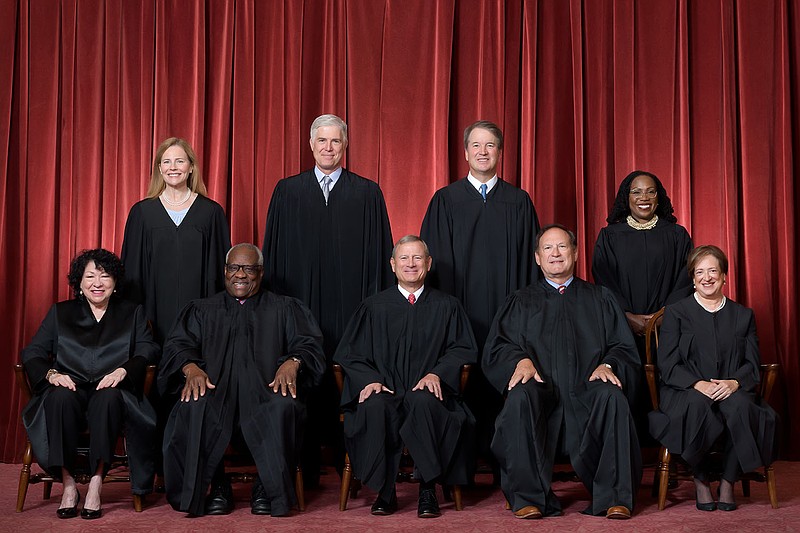
Formal group photograph of the Supreme Court as it was been comprised on June 30, 2022 after Justice Ketanji Brown Jackson joined the Court. The Justices are posed in front of red velvet drapes and arranged by seniority, with five seated and four standing...Seated from left are Justices Sonia Sotomayor, Clarence Thomas, Chief Justice John G. Roberts, Jr., and Justices Samuel A. Alito and Elena Kagan. .Standing from left are Justices Amy Coney Barrett, Neil M. Gorsuch, Brett M. Kavanaugh, and Ketanji Brown Jackson...Credit: Fred Schilling, Collection of the Supreme Court of the United States. Supreme Court of the United States
I don’t pretend to be an expert on anything but immigration and Bobby Sherman albums.
I can sing every verse of “Jennifer,” a song I’m sure you never heard of. I did, and I can tap out the beat on my vintage Bobby Sherman lunch box.
But I digress. While I am not an authoritative voice on a lot of topics, I do have informed opinions.
One of them is that using race to remedy racial discrimination is not constitutional. It simply is not.
“Simply” is the operative word here. Simplicity is often overlooked in favor of “nuance,” or as I wrote on Facebook:
“I’m always suspicious when people tell me that I just don’t get the ‘nuance’ in a particular controversy. Usually, the simplest interpretation is the correct one.
“For example, yesterday’s Supreme Court decision on voting rights is being decried as an evisceration of the Voting Rights Act and an attack on minorities, because a majority of the court found that legislative districts cannot and should not be gerrymandered by race.
“Somehow, this is being called a setback for racial minorities because inorganically structured districts that created false minority majorities are supposed to be ‘fair.’ When asked why, proponents say “look at history.”
“But history doesn’t justify a violation of the principle that voting rights are supposed to be color blind. They cannot be based on skin color alone, or religion, or class, or sexual orientation, or any other nonessential aspect of humanity.”
Of course, that’s considered simplistic, and people from the anonymous Facebook commenter to Barack Obama are crying foul.
What part of “race cannot be used as a factor in designing voting districts” is unclear?
Most of the people who responded to this post agreed with me, and the others were polite enough not to engage in bad-faith debates. But it really isn’t a question of whose opinion is better.
The idea that we can divide people by race never works. Look at segregation. That was a smashing success, right?
Now some readers will be absolutely apoplectic that I am comparing a dehumanizing tradition of classifying people by the color of their skin with a tradition of … classifying people by the color of their skin.
No matter how you try to spin it, gerrymandering voting districts to make sure that there is a majority of a “certain” sort of person is as bad when you do it in a reparative manner as when you do it in a hostile manner.
That’s because there will always be someone standing on the other side of the line that you randomly drew.
And I truly believe that classifying people by the least important part of who they are — the amount of melanin in their skin — is as demeaning as telling a wife that she has that “pre-widow glow.”
That, my friends, is the topic of a future column involving the poisoned apple being foisted on an unsuspecting viewing audience.
But yet again, I digress. It comes with what I call ADHD, or Age DHD. The older I get, the more stream-of-consciousness Joycean I become, so bear with me.
Former president Barack Obama wrote this on Twitter/X: “Today’s Supreme Court decision effectively guts a key pillar of the Voting Rights Act, freeing state legislatures to gerrymander legislative districts to systematically dilute and weaken the voting power of racial minorities, so long as they do it under the guise of ‘partisanship’ rather than explicit ‘racial bias.’ ”
You would think that a man who was touted as a constitutional scholar would have a slightly less partisan, slightly more reliable grasp of the document he presumes to teach.
What the Supreme Court did is the exact opposite of what Obama is accusing it of doing. It has essentially prohibited state legislatures from pacifying the most extreme and undemocratic members of society by creating race-based voting districts in the name of equality.
My father, Ted, is no stranger to readers of this column. Until I can no longer type, I will tell the story of how he left his pregnant wife, his two other children, his safe job in a white-shoe Philadelphia law firm, and traveled south to Mississippi in 1967.
He did that to help advance the cause of due process. He did not do that, and did not have a near miss with the KKK, so that some pretentious former president could write a stupid tweet about his beef with the Supremes.
He did not do that, so Justice Kagan could write a drama queen dissent. He did not do that so we could completely upend the whole idea of color blind justice.
He did that to advance the principle that was expressed by Justice Clarence Thomas 32 years ago when he wrote in another case involving voting rights, “The assumptions upon which our vote dilution decisions have been based should be repugnant to any nation that strives for the ideal of a color blind Constitution.”
Apparently, we are supposed to take off the blinders now and then, when progressive activists believe that it’s necessary to create the kind of society they can tolerate.
Fortunately, six justices on the Supreme Court have preserved the kind of society that doesn’t classify justice and equality by bloodline.
We spent too many years doing that, fought a war to stop that, and marched and died on that battlefield.
And my father risked his life for that. I’m glad it wasn’t in vain.
This piece originally appeared in the Delco Times.