What makes a city great?
First on my list would be a great department store, which Center City Philadelphia does not have. It's an urban tragedy of sorts: after all, department stores became central to retailing in American cities in the late 19th and early 20th centuries.
When Macy’s — formerly Wanamaker’s — closed, a big part of the city died. Macy’s was a community institution, and while it may have fallen on hard times before its closure, for many years the people who worked there took pride in the fact that they weren’t there just to sell but to offer the best in customer service.
Lit Brothers, another great Philly department store, used to have a slogan: “A great store in a great city.” But the demise of other department stores like Gimbel’s and Strawbridge & Clothier further diminished Philly’s status as a great city.
The Institute for Urban Research lists three things that make a great city: it (1) must be open to everyone, (2) has something for everyone, and (3) can attract and maintain demand.
Center City fails when it comes to (2) and (3).
On March 23, 2020, then-Mayor Jim Kenney, in conjunction with the city Health Commissioner Thomas A. Farley, issued a Covid-based stay-at-home order. This exercise in overreach and control was responsible for the closure of a number of very popular Asian buffet eateries, many of them located near City Hall. Fear and panic eliminated these easy-access restaurants where the array of food, from meaty to vegetarian, covered the waterfront. The absence of these eateries has left a hole in the city. More disturbing still is the fact that since Covid, no attempt has been made to bring them back.
Why? Is it fear that another pandemic may be on its way?
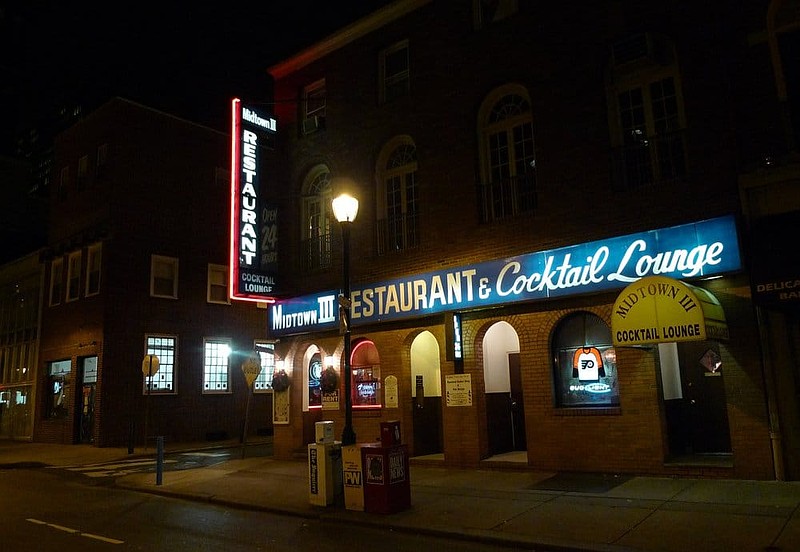
After the closure of those buffets, all the Midtown diners closed, leaving Center City without a 24-hour diner. If you can’t get a cup of coffee in a city at 2 a.m., then that city is not great. It’s wanting. (Don’t talk to me about how wonderful Parc is. It is wonderful, but every great city needs a handy 24-hour greasy spoon.)
Coincidentally, in 2022 the city’s population fell by almost 18,000 residents. Why did these people leave? Was it because of the BLM riots? Was it because after every Center City left-wing (or sports-fueled) riot, a store like Brooks Brothers was vandalized? (Brooks Brothers finally left Center City in 2024.)
For years, cosmopolitan elitists joked about how Philly and Pittsburgh were the only two places in Pennsylvania with a semblance of “culture.”
“We’re so much better than the middle of the state,” they pontificated. “We’re smart, we’re sophisticated. We don’t vote Republican. We are not Alabama!”
Yet “Alabama” got it right during Covid and proved way smarter than Pittsburgh and Philly. “Alabama” did not go into a Covid panic or shut down the way the state’s two leading big cities did. Many popular buffet restaurants in the middle of the state survived the Covid scare tactics Democratic politicians were selling.
Today, if residents of Philly — who look down on the inhabitants of “Alabama” — want a good buffet they have to travel out of Philly because Democrats here are still living in a lockdown mentality, whether they realize it or not. Philly has mostly failed to reinvent itself after the lockdown. Whether this is due to entrepreneurial laziness or apathy, I can’t be certain.
What’s undeniably true is that the growth of leftism in the city is contributing to its demise. Left-wing politics breeds DA Larry Krasner policies, an uncontrolled landscape of homelessness and drug addiction, and a mentality like the policies in today’s Germany where because of the migrant crisis, it’s no longer safe for women to walk the streets there. (Rather than call out the migrants as the cause of the situation, German politicians have proposed issuing vouchers for women to take cabs and rideshares. Other proposals include earmarking certain subway trains for “women only.” An easier solution, of course, would be to expel the migrants.)
Since 2020, the disappearance of the 24-hour city is more noticeable than ever. In my Port Richmond neighborhood, you used to be able to get a sandwich or a cup of coffee at 3 a.m., but today you had better get your order in before 11 p.m., because every business will close long before the stroke of midnight. Every business here shuts down at the same time like a synchronized watch – the excuse is crime, shoplifting, and unruly homeless people who act out in various ways. Everybody suffers for the faults of a few.
The goal seems to be to make city life as dull and controlled as possible.
I’ve noticed that many city Dunkin’ operations since 2021 have removed in-store tables and chairs. When I asked the manager of one store on Aramingo Avenue where all the tables went, I was told they were removed because of the homeless. All food is take-out, but where do you eat it if you are not riding in a car or if there’s no park bench or a park nearby? A small picnic table near a baseball field in my neighborhood – a staple for decades – was recently removed because of the homeless. Quaint little benches positioned next to trees or on small traffic islands, have also disappeared, because of the homeless.
How smart is it to “redesign” a city because of the effects of homelessness, drug addiction, and crime? That’s precisely what Philly is doing.
In 1960, TIME magazine published an essay on what makes a great city.
“A great city is always tolerant, even permissive, and provides outlets for a wide range of human pleasures and vices,” the essay proclaimed. (You read that right: TIME magazine actually advocated for “vices.”) But downtown Philly at night in 2026 is a rather sterile and sanitized affair; it’s nothing compared to the Philly of the 1970s, which was over-the-top when it came to real diversity: strip bars, cheap beer halls where the jazz drowned out the noise of occasional fights, and multiple peep shows and sailor hangouts around 12th and Filbert Streets.
Cities that are not great, the essay continued, also have things in common:
“They all lack the most important element: spontaneity of free human exchange…. Grand avenues and impressive architecture, though necessary to a great city, do not satisfy the equation. If the Third Reich had lasted another ten years, Berlin, which Hitler planned to rename Germania, would have become the world’s most monumental city. It also would have been the most monumentally dull.”
Monumentally dull – that sounds a lot like Center City after midnight.