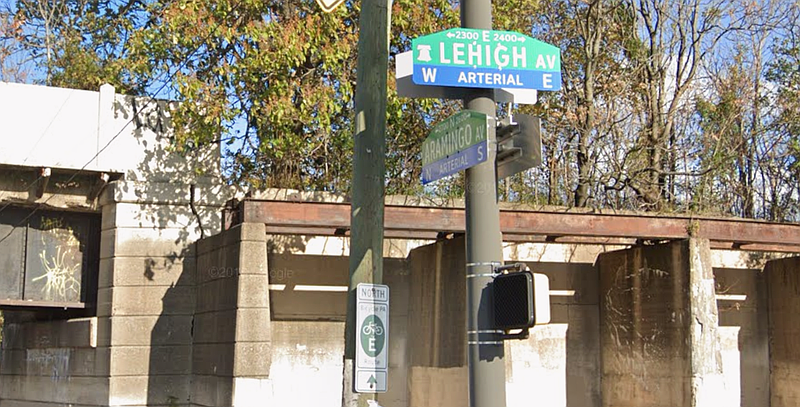
On Sunday, April 12 at 8 p.m. a man on bicycle was riding in the bike lane under the bridge at Aramingo and Lehigh Avenues when he was hit by a car that swerved into the bike lane. The victim was tossed into the air and then lay unconscious on the pavement, bleeding profusely. A passerby noted the license plate of the car and then attended to the cyclist, who later died at the hospital.
The car that hit and killed 43-year-old Glenn Colville, Jr., sped away as if life was a video game and the person hit was just another “Bingo” moment. The car was seen stopping at a laundromat on Aramingo Avenue. News reports vary on the people in the car.
NBC News said that a group of young people got out of the car and fled the scene on foot. Other news outlets reported that a group of “young people” fled the scene on foot, while NBC later reported that the people in the car were actually juveniles.
Juveniles, as in middle school?
The driver of the car, allegedly the twenty-one-year-old daughter of a man who owned the vehicle, was questioned by police but later released. Nothing more was said about the driver; her name was not published (ditto for her picture), and neither was what she may have told the police about why she swerved into a bike lane and killed a man.
Why is this information being kept a secret? Was the driver drunk? Was she on her cell phone? Why was she questioned and then mysteriously released without a word of explanation by police?
What’s stranger still is that after releasing the suspect the police continued to ask the public to come forward if they had any information on the hit-and-run.
The unwillingness of officials to release any information on the driver to the family of the dead man is like a second death.
Most hit-and-run fatalities are hard enough to process, but when a hit-and-run driver is actually tracked by eyewitnesses, apprehended but then freed without a word of explanation, you have a case that gives off rotten vibes.
And this case stinks to high heaven.
The eyewitness who saw the car swerve and hit Glenn Colville, Jr., and managed to get the license plate number of the car did a perfect job identifying the suspects. The other eyewitness who apparently spotted the car coming to a full stop at the laundromat and saw three juveniles rush from the car was, I presume, in his right mind.
Colville’s family deserves answers. Officials need to come clean and state why the driver was released when it was that very car that killed Glenn Colville, Jr.
The official silence on this issue has given birth to many rumors. That’s usually the way it is when communication shuts down. Many people in Colville’s Riverwards neighborhood feel the driver is being protected. They view the case as “political.” Some have theorized that the driver is a relative of some city official. This may be true. It also may be an insane conjecture. But this is what you get when issues like this are shrugged off, and family and friends of the victim are left guessing.
I did not know the man who was killed but I know men who knew him. News reports never mentioned the fact that at the time of his death he lived in the woods near the Delaware River, where some homeless people have tents and build makeshift shelters. For a short while after his death, police were unable to determine his identity because he had no ID.
The important thing here is the fact that a man was killed, and he was killed in an awful way. He was riding his bike and following the rules when a “crazy killer” car came up behind him, swerved, hit him and sent his body flying. That’s murder.
Murder II, as I stated, is when the culprit car is identified but the driver of that car is treated with velvet gloves, given a free pass — and maybe even a pat on the cheek — and then released without a word of explanation.
An apparent travesty like this should not be acceptable in a civilized society.