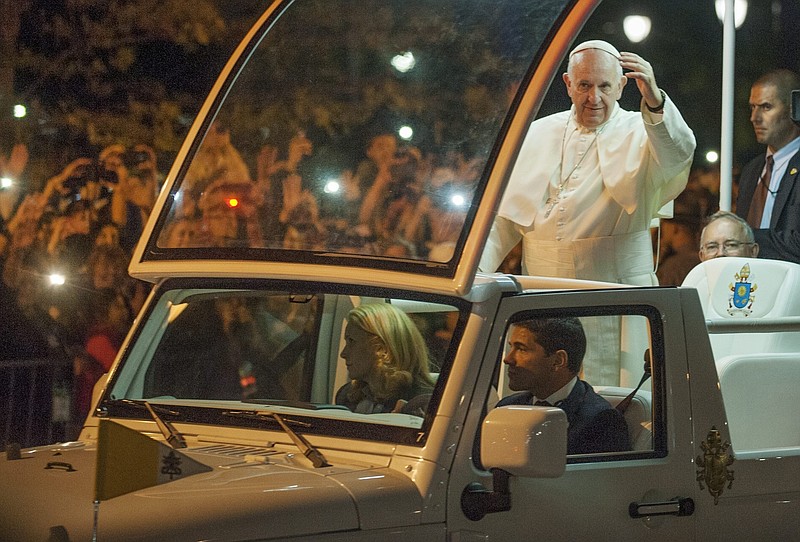
Pope Francis arrives to the Festival of Families held on the Benjamin Franklin Parkway in Philadelphia on Saturday, September 26, 2015.
Before his death, Pope Francis created a forum for lay Catholics, theologians, and clergy to discuss a number of topical issues in the Church. These issues included women’s ordination, the creation of a female deaconate, LGBT or same-sex attraction, and assisted suicide, among others.
While the findings of the Synod would not immediately change Catholic doctrine, the suggested changes would be formally archived and used as Vatican-approved references for possible future reforms. In many ways, Francis’s Synodal Way might be compared to an ongoing Vatican III, a Council without end that could be reactivated when there’s a need to reconfigure old doctrines. The new Synodal Church has been billed as a “listening Church.” Many critics have called this the creation of a totally new religion.
In Germany, for instance, the Synodal Way has Catholic life in its grip. Currently there is a proposal in that country to have lay people select bishops and seminarians. This means that people in the pews will vote on who becomes a priest or heads a diocese.
More than a few conservative Catholic priests, theologians and commentators have issued warnings about the Synodal Church, saying in effect it is the creation of a new Catholicism divorced from the Church of the ages.
When asked if the Church would ever change its teachings on homosexuality or women priests, Pope Leo during one of his airplane interviews said, “First, we have to change attitudes.” This implies a definite ‘yes’ answer to the question, but only after attitudes have changed. And how do you change attitudes? You first appoint as many liberal bishops as you can to help Catholics get in step with the new policies.
According to this logic, we can expect the Catholic Church in the future to say it was mistaken for 2,000 years in classifying homosexuality as a sin. This implies that one day sacramental gay marriage will become the norm in the Church.
But how reliable is the Synodal Way when it comes to doing their homework on controversial issues?
One major report by the Synod’s General Secretariat — “Theological Criteria and Synodal Methodologies for Shared Discernment of Emerging Doctrinal, Pastoral, and Ethical Issues” — contains an outright lie.
This lie was published on May 5, 2026, and created quite a bit of controversy in the Catholic world.
The lie takes one gay man’s experience with the Church-approved group, Courage International, a support group for Catholic gays who follow current Church teachings on homosexuality (gays must remain celibate), and twists it into what many are calling an outright “calumny and detraction against the organization and its members.”
Since the early 1980s, Courage International has been the Church-approved and championed support group for people with same sex attraction, while Dignity USA, the ad hoc Catholic group that encourages Catholics to live out their same-sex attraction in physical relationships and love affairs, has always been the unapproved Church organization.
From its founding in 1969, Dignity groups in various cities were always being kicked out of Catholic churches. Dignity priests had to remain anonymous for fear of retribution from bishops. In Philadelphia, Dignity at first was forced to hold meetings and Masses in private homes and storefront spaces. It eventually found a permanent home at St. Luke’s Episcopal church in Center City.
I was a member of Dignity for a short time. The Masses there started out as dignified affairs; in other words, they followed traditional liturgical norms but over time as political correctness and early forms of wokeness began to change the gay and lesbian movement, the Masses reflected this shift. Sometimes women “priests” said the Masses. There were also language and pronoun changes in homilies and scripture readings. It didn’t help that the hymns at those Masses seemed more Pentecostal than Catholic.
The gay anonymous man in the Synodal report described Courage meetings as “secretive and hidden” and participants as “lonely, hopeless, and often depressed.” (Walk into any gay bar and you might have a similar impression.) The implication here is that because Courage encourages chastity, the men in question suffer from sexual repression or the lack of sexual expression. The Synodal report seemed to be saying: Hot sex or maybe even an orgy would put a smile on that face of yours!
The unnamed man in the synodal report also alleged that the Courage meetings he attended were “secretive and hidden.”
When I contemplated joining Courage a number of years ago, I contacted the organization and received an email from a priest who offered to meet me in private before divulging the location of the meeting. I thought this to be overkill and never followed through. Courage responded to the unnamed man in the synodal report by saying its meetings “are confidential and secure so members can speak candidly about their struggles.”
Well, perhaps it’s time for that kind of secrecy to end. Perhaps it’s time for Courage members to come out of the spiritual closet like their pro-sex brothers and sisters did in 1969. Come out and announce yourselves as celibate and end the social stigma and the rumors.
The Vatican report took the comments of one gay man without getting a comment from Courage, and what’s worse, it also concluded from this gay man that Courage was involved in reparative therapy, or turning a homosexual into a heterosexual, which in society used to done via electroshock therapy.
Courage has never been involved in such madness. The organization has only advocated chastity: you cannot change sexual orientation unless a person is inherently bisexual. Even then you’re changing nothing, you’re just having the bisexual switch gears.
This lie casts the entire Synodal Way in a dubious light. Some Catholic thinkers and clergy have even called the Synod diabolical and call for it to be shut down. I tend to agree with them.
The authors of the lie include Cardinal Carlos Castillo Mattasoglio of Lima, Peru, known for his theologically heterodox positions. Another author, Jesuit Father Carlo Casalone, a moral theologian, announced his support for assisted suicide in 2022.
The astute and articulate Fr. Gerald Murray, who worked with Courage International in Manhattan, criticized the synodal process for creating confusion about the Church’s doctrinal clarity. Fr. Murray in one podcast said that his Courage group was composed of the most wonderful intelligent, reverent and faithful men he has ever met. These men, he said, had a better spirituality than most priests.
About the Synod’s lie, he stated:
“This is an outrage…. Courage, which is a faithful apostolate to help Catholics who struggle with homosexuality — I’ve worked with them for many years — they’re denigrated, they’re criticized, they’re put down. Why don’t we have testimony from a Courage member about how you can live with a homosexual orientation in chastity and fidelity to the Gospel? There’s none of that. There isn’t because this is a propaganda effort.”