My father died of throat cancer in 1986. At the time I was working in Human Services with the developmentally disabled in Germantown.
I grew up at a time when it was understood that there should be some emotional distance between fathers and sons. My father never held or kissed me in public like I see many fathers doing today with their toddler sons. That kind of closeness then would have been perceived as excessive and unnatural. Tactile kissing and hugging were the business of mothers. As a result, I grew up fearing my father. He was a disciplinarian and a task master. This is not to say he didn’t love me. He did. He just couldn’t show it.
At times I’d take revenge on him by posting little notes around the house calling him Hitler. As you can imagine, that didn’t go off very well.
I should note here that I was the eldest of six children. Being the first born, you are likely to be the experimental child in your parents’ eyes. My parents were under twenty when they married, so when it came to raising me trial and error was the norm. Not surprisingly, by the time my youngest sister was 15 or 16, she had it much easier than her older siblings. She and my father considered themselves buddies. Discipline was lax; in another sense, sometimes I felt that my sister got away with murder.
I’m writing this to lay the groundwork for what would happen later; when political ideology got the best of me when I was in my twenties, and when that ideology dictated certain actions of mine after my father’s death.
This action – a blunt refusal to attend my father’s funeral – was the result of my allegiance to gay ideology. In a nutshell, although my father and I became close long before his death, after his death when the funeral arrangements were laid out by my mother, I was told in no uncertain terms that my partner at the time and I could both attend the funeral as a twosome but we could not take part in a special ceremony after the Mass where my siblings and their spouses went to the front of the church and stood as couples around the casket.
The purpose of the “couples’ line” was to meet and greet the mourners.
I had never heard of a ceremony like this; apparently it was one of those post Vatican II ideas that disappeared almost as soon as it was invented. My mother was adamant: “I cannot have you and ‘S’ standing with the other spouses. The family isn’t ready for this. My sisters aren’t ready to see this. You must respect my wishes. ‘S’ can remain in the pews while you come up and join your siblings, but I can’t have ‘S’ standing there with you. Please respect my wishes.”
This directive didn’t go down well. Here I was, having spent a few years in Harvard Square and Boston demonstrating with the Gay Liberation Front, writing for underground gay newspapers as a committed dyed-in-the-wool gay activist. Acceding to my mother’s wishes would have meant betrayal of the gay movement. I saw myself as a potential hypocrite, writing and preaching that everyone should come out of the closet while I slinked back into the closet for the duration of a church service just to appease my mother’s sisters, and to prevent them from being shocked, even though they already knew my story. Yet in 1986, standing in front of my father’s casket in church with my partner ‘S’ was perceived as “rubbing it in their faces.”
I thought my mother’s request was monstrous, especially since she and my father both accepted ‘S’ at family dinners and holiday gatherings.
“There’s no way that I can do that,” I told her. “S’ is every bit a part of my life as the spouses of my brothers and sisters are. You’re telling me to deny that; you’re telling me to relegate ‘S’ to second tier status. Can’t you stand up to your sisters? Why should they dictate how you arrange Dad’s funeral?”
My mother was unmoved. When I talked to a gay friend about it, he told me not to bend to her wishes. “He’s your partner, you can’t betray him. You’re not a teenager living under her roof. You’re an adult. She doesn’t respect your relationship.”
I resolved not to go to the funeral.
On the day of the Mass, the burial at the cemetery and the luncheon afterwards, I was not present. The cold embrace of stubborn ideology offered few emotional comforts. In my mind I was with the family at the funeral Mass, even as I pushed doubts about my decision out of my mind.
I kept telling myself: Yes, I had done the correct thing. After all, I had a message to convey: the equality of gay people. My not going was really an affirmation of that fact.
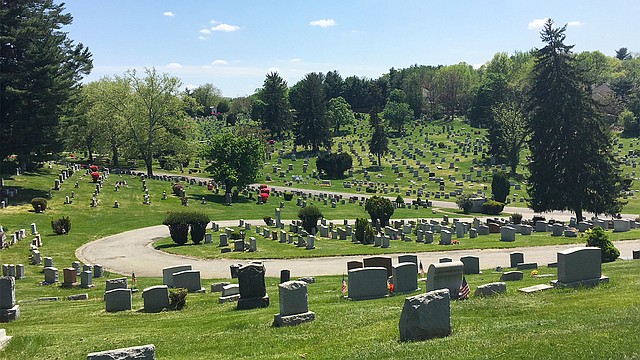
With a small group of friends, we headed to Westminster Cemetery in Bala Cynwyd where my father had just been buried. One of my friends brought incense and some ceremonial Native American paraphernalia. We conducted our own ceremony around the grave. Waving a feather and incense sticks over the earth, we held hands in a circle and said some prayers.
At the cemetery, the site of my father’s grave filled me with immense sorrow. The mountainous pile of flowers spoke to the many people who loved him. Doubts about boycotting the funeral flooded my being; they rushed in like shadows and filled me with dread. What had I missed? Had I chosen ideology over properly mourning my father?
It would be a number of years before I realized my mistake. ‘S’ and I never stayed together. We would split four years from the date of the funeral. You only have one father and that father only dies once. I could have given into Mother; I could have swallowed my gay pride and thought of her needs after a marriage of almost 30 years. I could have compromised.
The experience caused me to be less critical of ideologically driven young people as they prance about today insisting on pronouns or the correctness of their opinions. I recognize that arrogance because I was once one of them.
That’s a country I inhabited a long time ago. But the past is the past.